



























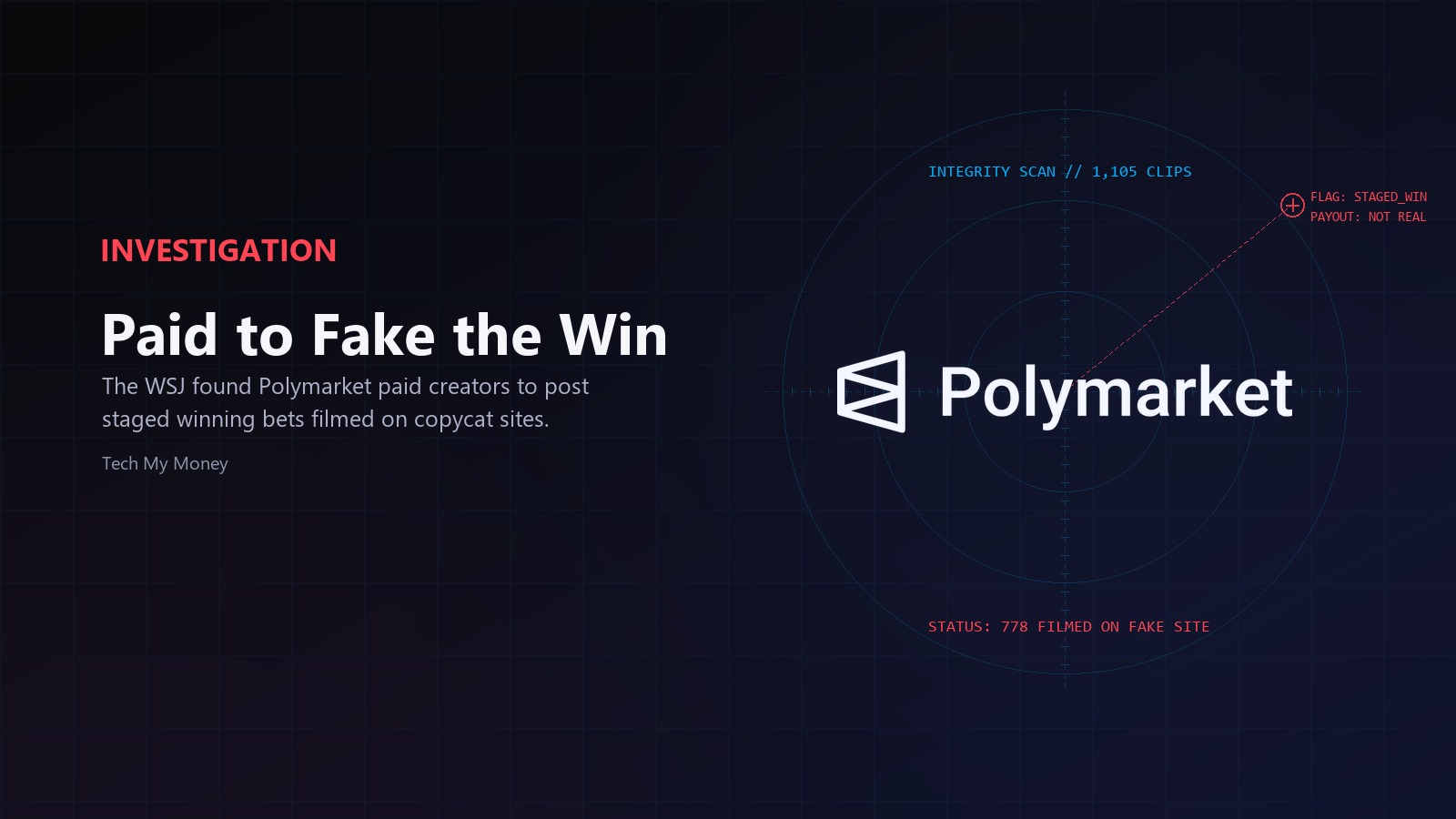
Polymarket paid a network of online creators to film themselves cashing in on bets that never actually paid out. That is the core finding of a Wall Street Journal investigation published this week. According to the report, Polymarket fake betting videos were staged on near-perfect copies of the real platform. The clips were then pushed across TikTok, YouTube and Instagram by a coordinated clipping operation.
In total, the Journal reviewed more than 1,100 of these videos. Roughly 778 of them appeared to show trades placed on dummy websites rather than on Polymarket itself. In other words, the wins that helped sell the platform to American audiences were frequently manufactured.
What the WSJ investigation found
According to the report, Polymarket worked with dozens of mostly college-age creators. The company then paid them to post the clips. The money was not trivial, either, because the pay often added up to between $2,000 and $3,000 a month per creator.
On screen, the staged content was strikingly profitable. In one slice of the data, 145 videos appeared to show bets adding up to almost $410,000. Yet more than half of the clips depicting a winning bet actually represented a loss, the Journal found. Meanwhile, the broader clipping campaign racked up over 140 million views.
Polymarket and a marketing contractor also supplied guidance materials so the videos would look convincing. After that, a “social-media army” amplified the footage, with reposts coordinated around a core group of creators. Crucially, the creators were told not to disclose that they were paid. Once Journal reporters started asking questions, some of them quietly added “@polymarket partner” to their bios.
The insider-trading angle
The most uncomfortable detail involves trading on non-public information. According to the Journal, internal materials promoted videos showing how easy it is to act on inside knowledge. On top of that, paid clippers pushed at least 19 videos discussing the use of inside information. That framing lands awkwardly, because Polymarket has spent months trying to shake exactly that reputation.
Regulators and prosecutors are already circling the prediction-market sector. Tech My Money recently covered the case of a Google engineer charged in a Polymarket insider-trading matter. Rival Kalshi, meanwhile, has started asking some traders for employer details to police the same problem. Encouraging creators to romanticize inside-information bets cuts directly against that cleanup effort.
Why the fake wins matter
The deception works because of where Polymarket sits legally. Its core platform is still barred from serving United States customers. As a result, many of the people watching these clips cannot legally place the bets being shown to them. We explored that gap when Polymarket made VPN workarounds a much riskier bet for US users earlier this year.
So a steady feed of staged jackpots becomes a powerful marketing tool. Viewers see ordinary young people apparently turning small stakes into thousands of dollars. The platform, in turn, gains credibility it has not actually earned. The reality, per the Journal, is that the screens were copies and the payouts were fiction.
Polymarket’s response
When the Journal asked for comment, Polymarket said it plans to conduct a comprehensive audit of active promotional content. The company added that it is “committed to maintaining accurate, fair, and transparent markets.” It also said it is “part of a rapidly growing industry” and is “constantly evaluating ways to improve how we’re engaging and earning the trust of our audience.”
That audit will be worth watching. Polymarket is currently riding record trading volume and growing mainstream attention. Yet this report suggests some of that momentum was built on clips designed to mislead. For now, the safest takeaway is simple. A viral video of someone winning big on Polymarket is not proof that anyone won anything at all.