





























Polymarket VPN restrictions are turning the prediction market’s most obvious workaround into a liability.
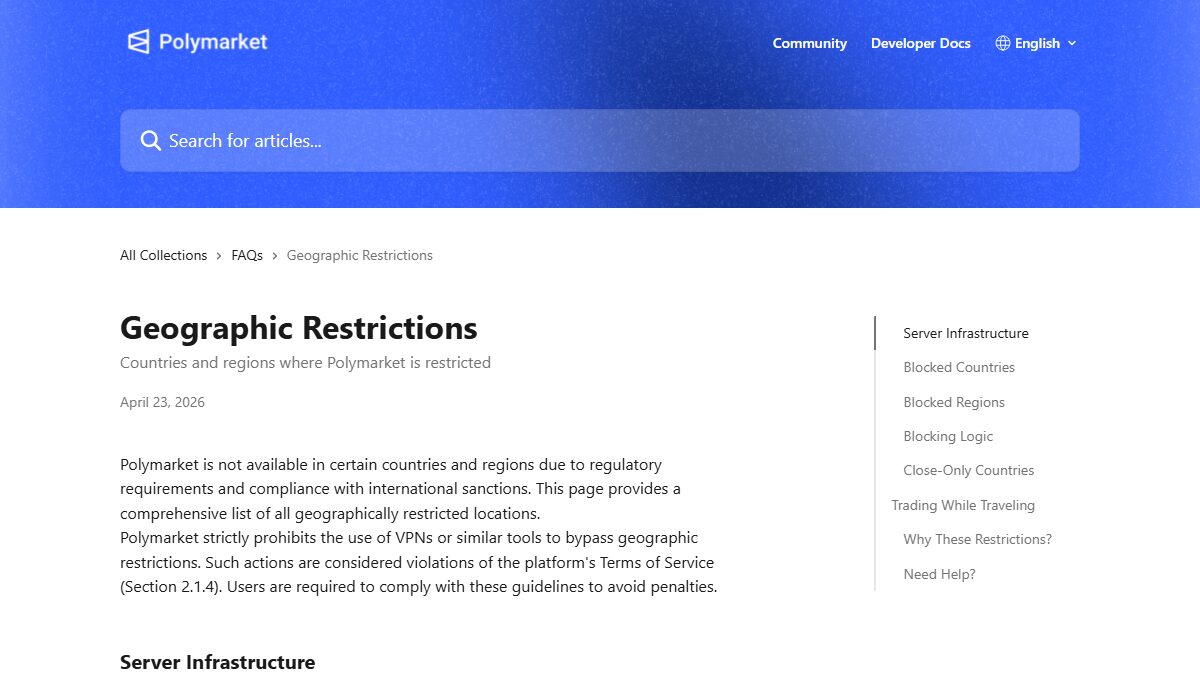
Polymarket’s own help page says the platform is not available in certain countries and regions because of regulatory requirements and sanctions compliance. It also says using VPNs or similar tools to bypass those limits violates its terms of service.
The Block List Is Not Tiny
The company lists 33 fully blocked countries. The list includes the United States, United Kingdom, Germany, France, Italy, Australia, Singapore, Japan, Poland, Russia, Thailand, Taiwan, and several sanctioned jurisdictions.
Polymarket also lists specific blocked regions. Ontario in Canada is restricted, along with Crimea, Donetsk, and Luhansk in Ukraine. Some countries sit in a close-only status, where users may close positions but cannot open new ones.
That makes the VPN issue more than a technical cat-and-mouse game. If a user is trading from a blocked place, the problem is not just whether a VPN server loads the website. The problem is whether the account activity violates platform rules or local law.
Prediction Markets Are Growing Up the Hard Way
Polymarket became popular because it felt fast, global, and crypto-native. That same openness is now colliding with gambling law, financial regulation, sanctions rules, anti-money-laundering expectations, and know-your-customer requirements.
For platforms, the pressure is obvious. More volume brings more attention. More attention brings regulators, payment questions, and identity checks. Polymarket is now trying to keep the market open where it can while drawing harder lines where it must.
The lesson for users is boring but useful. If a market platform says your region is restricted, a VPN does not magically fix the compliance problem. It may only move the risk from the login screen to the account level. That is a bad place to discover the fine print.