
























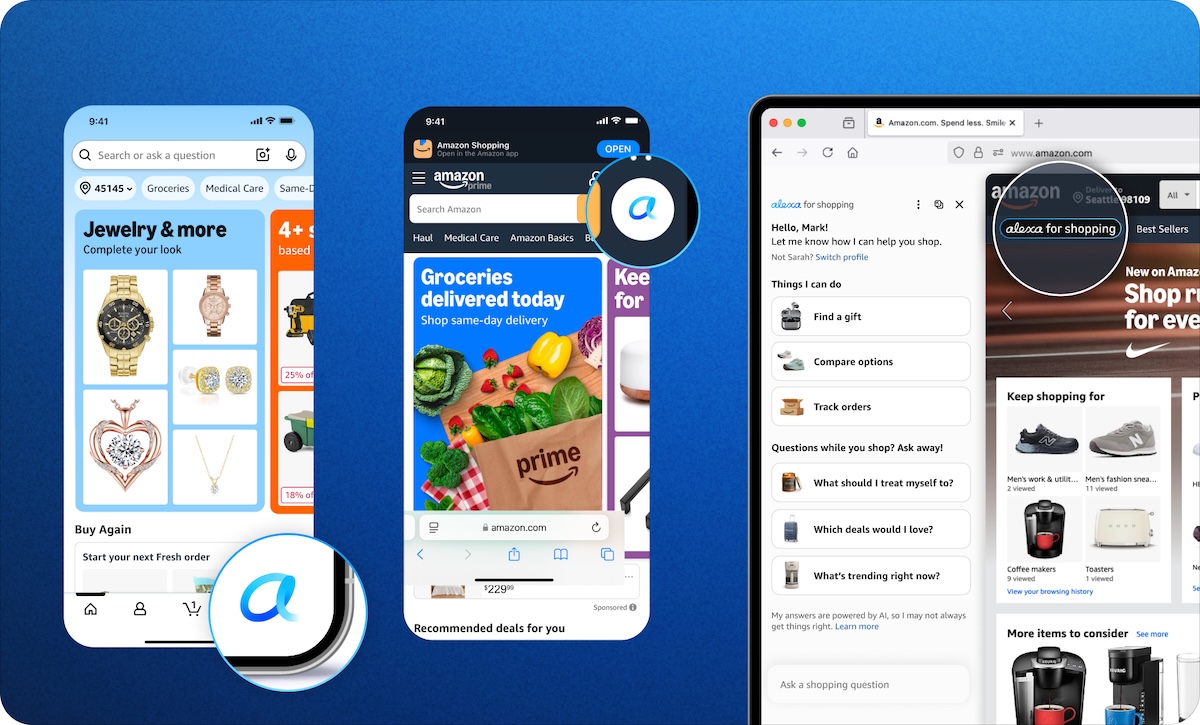
Amazon Alexa for Shopping launched today. Amazon also retired Rufus, its standalone shopping chatbot. Instead of a separate panel, Alexa now lives directly inside the main search bar. It works across Amazon’s website, app and Echo Show displays. You don’t need Prime, an Echo device or a separate app. Any signed-in US account gets it free.
What Alexa for Shopping Actually Does
Alexa for Shopping works as a conversational layer on top of Amazon’s full catalogue. You can ask questions directly in the search bar. For example, try “compare these two standing desks” or “when did I last order AA batteries.” The assistant then uses your order history, browsing behaviour and past conversations to shape the answer. Category overviews, side-by-side comparisons and AI-generated product summaries also flow into the standard search and product page experience.
The price tracking is substantive. Alexa for Shopping shows up to a year of price history on hundreds of millions of products. You can also set drop alerts for any item. Additionally, Auto-Buy adds an item to your cart once it hits your target price. That feature requires explicit setup. Alexa won’t act on your behalf without your permission.
Scheduled Actions Are the Agentic Move
The most significant new feature is Scheduled Actions. You define a shopping task once. For example, reorder coffee every three weeks or set a birthday gift reminder for mid-October. Alexa then manages the timing and conditions without prompting. That is what agentic means in practice. The assistant acts on your behalf based on rules you set, not just answers questions on demand.
Alexa for Shopping also has a Buy for Me feature. It handles purchases from eligible third-party retailers through a programme Amazon calls “Shop Direct.” Amazon hasn’t revealed which retailers qualify yet. Even so, the feature signals that Amazon sees Alexa as a shopping agent beyond its own walls.
Why Amazon Is Making This Move Now
Rufus handled over 300 million customer interactions in 2025. Amazon folded that knowledge into Alexa+ and moved the result into the search bar — where buying decisions actually happen. Meanwhile, the competitive pressure is real. OpenAI has Instant Checkout. Google runs Buy for Me inside Gemini. Perplexity’s Comet browser handles purchases through PayPal. After all, Amazon’s $56 billion advertising business depends on capturing high-intent buyers before they go anywhere else. An external AI agent stepping between the user and that search bar is an existential threat to that model.
Alexa for Shopping rolls out to US customers this week. It will expand internationally alongside the broader Alexa+ rollout through 2026. For more context on how AI reshapes major platforms, our look at Google’s Googlebook covers how Google makes the same push on the device side.