

























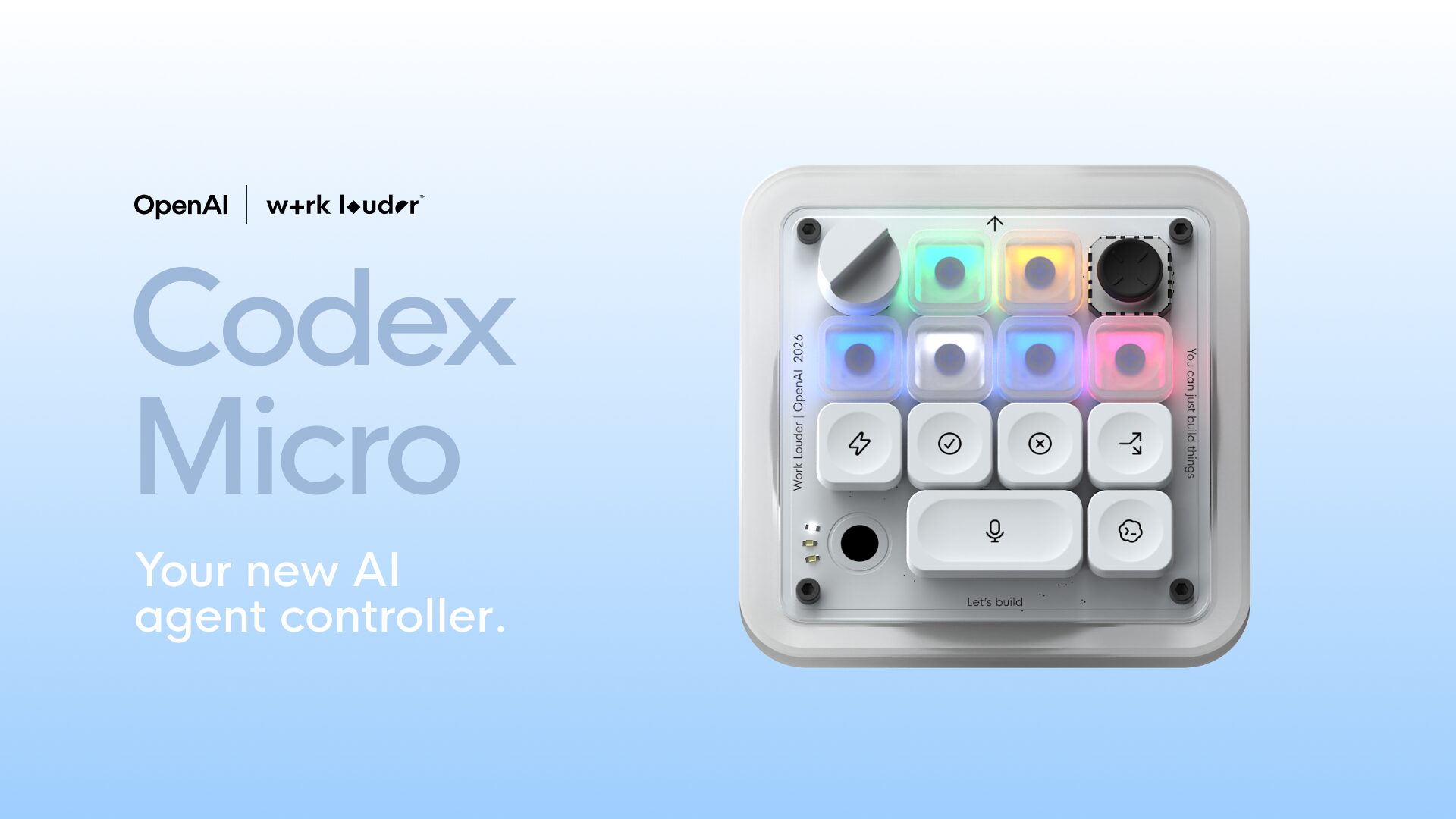
OpenAI Codex Micro is OpenAI’s first shipping hardware, and it is not the rumored smart speaker. With keyboard maker Work Louder, OpenAI launched this compact keypad to control Codex agents. It is available to order now for $230.
Codex Micro acts as a command surface for agentic coding work inside OpenAI’s Codex / ChatGPT desktop workflow. Instead of hunting through menus while agents run, the hardware keeps status and high-frequency actions under your fingers. In other words, it is a physical control layer for agent sessions.
What OpenAI Codex Micro actually is
If you have seen Work Louder’s Creator Micro family, the shape will look familiar. Codex Micro is a small custom controller with mechanical switches, RGB lighting, remappable keycaps, a rotary dial, and a planar joystick. OpenAI and Work Louder describe it as a command center for agentic work, not a general typing keyboard.
However, the standout idea is live agent status on the keys. OpenAI says each Agent Key can light up with RGB status from Codex. You can see whether an agent is idle, thinking, running, waiting, or done before switching chats. Therefore the core pitch is glanceable multi-agent awareness without babysitting every pane.
Controls that map to agent work
Beyond the status keys, Codex Micro focuses on a few dedicated control ideas:
- Command keys for frequent actions such as accept, reject, push-to-talk / voice input, and starting a new chat.
- A reasoning dial so you can raise or lower Codex reasoning level in the moment — faster for simple tasks, heavier when the job needs more thought.
- A joystick for launching common Codex workflows, with OpenAI citing examples like reviewing a PR, debugging an error, or refactoring code.
- Remappable keycaps, including extra icon caps, so the physical layout can match the shortcuts you actually use.
Additionally, Work Louder points to deeper customization through its Input software, including programmable layers for grouping workflows. OpenAI stresses direct integration with Codex / ChatGPT Codex. Because of that, this is different from a generic macro pad that only sends keystrokes.
Specs and what’s in the box
According to the official product materials, Codex Micro includes:
- Connection: Bluetooth and USB-C
- Compatibility: Mac and Windows
- Lighting: RGB
- Build: CNC polycarbonate and aluminum, sandblasted anodized bottom, PBT/PC keycaps, rubber joystick cap, POM/POK switches
- Inputs: 13 mechanical switches, 1 touch sensor, 1 rotary encoder, 1 planar joystick
- Keyset: 32 custom icon caps and 11 solid color caps called out across the product pages
- Software: ChatGPT Codex and Work Louder Input
- Included: the Codex Micro unit, USB-C to USB-C cable, and a Codex icon keyset
Price, availability, and the wider OpenAI hardware picture
Codex Micro lists at $230. You can order it from both OpenAI’s Supply Co. collaboration page and Work Louder’s store. Work Louder describes supply as limited quantity, so this looks more like a constrained co-lab drop than a mass-market accessory that will stay in stock forever.
Context matters here. OpenAI has been turning Codex into a broader productivity surface that sits closer to ChatGPT Work and agent tooling. Those agent workflows do not require dedicated hardware. Codex Micro is optional diehard gear for people who want tactile control, not a requirement for using Codex.
It is also the least complicated of OpenAI’s hardware threads right now. Beyond software and model launches like the GPT-5.6 public rollout, a separate rumored speaker product has already drawn legal noise. That includes Apple’s trade-secret lawsuit involving former Apple employees now at OpenAI. Codex Micro sidesteps that mess. It ships as a focused accessory with a clear collaborator and a buy page today.
Who this is actually for
This is not a mainstream consumer gadget story. Instead, it is a power-user accessory for people already living in multi-agent coding sessions. That audience cares about accept/reject loops, reasoning depth, and keeping several agents visible at once. If you rarely run Codex agents, a $230 keypad is easy to skip. If you do, the bet is simple: less context switching, faster approvals, and status you can see without opening every thread.
Whether the integration feels first-class will depend on how completely Codex exposes live agent state and actions to the hardware over time. Still, on launch day the verified facts are narrower and clearer. OpenAI and Work Louder are selling Codex Micro now. It costs $230. And it is purpose-built around agent status, command keys, a reasoning dial, and joystick-triggered workflows.