



























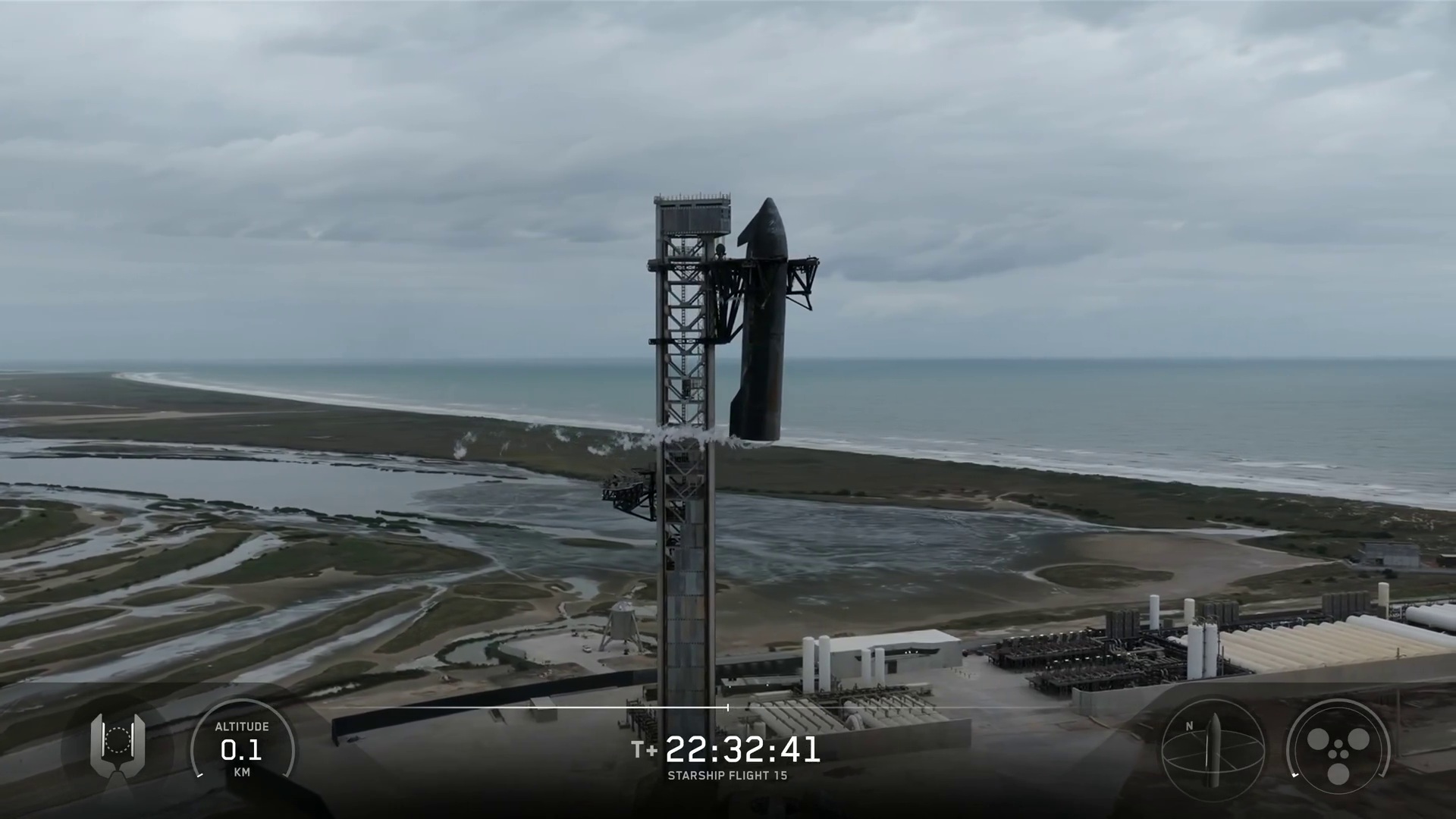
SpaceX completed its first Starship upper-stage catch on Saturday, November 14. The spacecraft returned to its launch tower at Starbase, Texas, about 22.5 hours after liftoff. The company’s Flight 15 mission report confirms the recovery, but the Super Heavy booster did not return to the tower.
The flight launched on November 13 and deployed 26 Starlink V3 satellites before the ship headed home. Flight 15 recovered the spacecraft and delivered its satellites. The booster was lost, and the underlying cause remains under investigation.
How the Starship upper-stage catch worked
After reaching space, the upper stage briefly coasted before restarting one Raptor engine to enter orbit. SpaceX says controllers monitored the ship’s systems for more than 20 hours before preparing its return.
A single sea-level Raptor engine then fired to take the spacecraft out of orbit. The ship crossed back through the atmosphere and approached the Texas coast. It then made a final maneuver over the Gulf toward Starbase.
Three engines ignited for the landing flip and final descent. The tower’s arms closed around the upper stage, completing its first catch. The return adds a new milestone to the program’s orbital testing. Our earlier Flight 14 preview covered the planned move to orbital flights.
Why Super Heavy missed its catch
SpaceX says the booster’s return burn ended early because of low fuel mass. Its guidance, navigation and control system automatically aborted the return during the coast phase. The vehicle diverted to an offshore landing location.
The booster performed a landing burn and hovered over the Gulf before its engines shut down. SpaceX says its flight termination system then activated. The company is still investigating the root cause of the low-fuel condition. Low fuel alone does not fully explain why the failure happened.
What happened to the Starlink payload
SpaceX reports that all 26 satellites made contact after deployment. They have begun raising their orbits to join the Starlink constellation. Deployment does not mean they are already serving customers. This mission report gives no customer-service start date for those satellites.
The same report does not specify a date for flying the recovered ship again. For now, the confirmed result is a first upper-stage catch. Recovering both stages on this flight remained out of reach.