

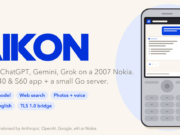






















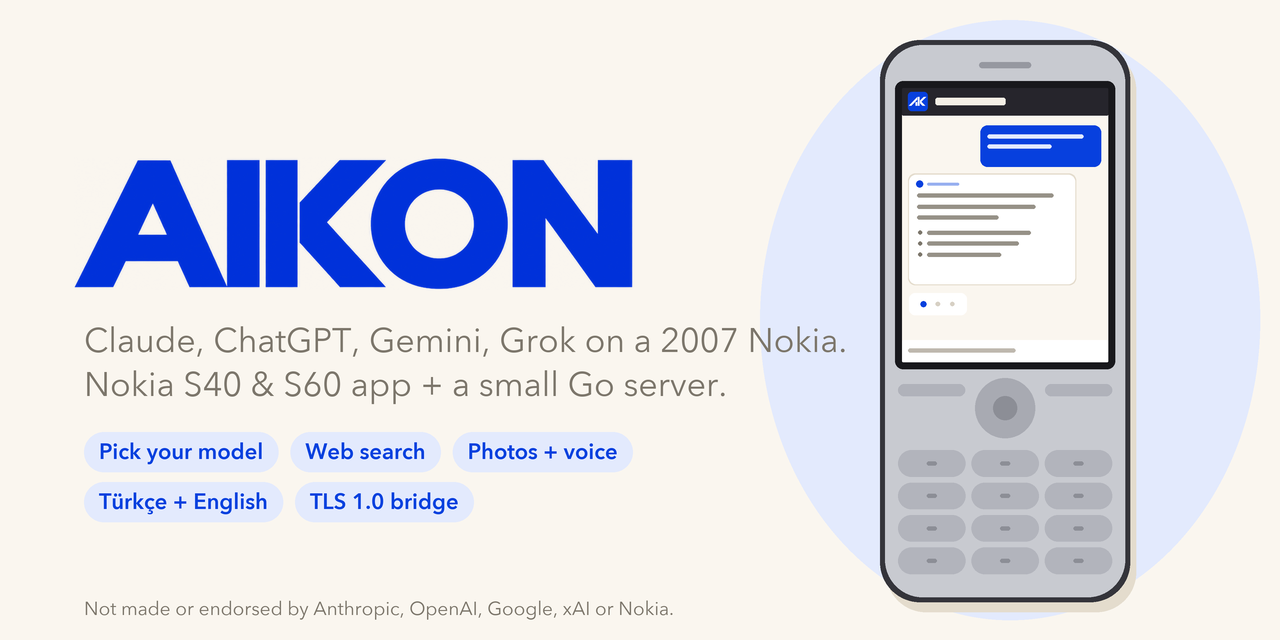
A Nokia 6300 AI project called AIKON gives the 2007 keypad phone a way to chat with modern models. Developer Emir Karşıyakalı’s open-source project pairs a Java app on the phone with a server that contacts Claude, OpenAI, Gemini or Grok.
The model runs remotely. The phone acts as the interface, sending a request over a working connection and displaying the reply. That distinction makes the idea more interesting than a claim that a nearly two-decade-old feature phone can run a modern chatbot on its own.
How the Nokia 6300 AI bridge works
Originally called Claude S40, AIKON now supports several model providers. The developer says he tested it on the Nokia 6300 and the Nokia E63, a Symbian S60 phone with a physical keyboard. Other compatible Java phones may work, but the project does not present them as tested.
Specifically, the 6300 speaks an old version of HTTPS that modern services often reject. AIKON’s Go server accepts the phone’s connection and then connects separately to the chosen provider. It also serves long answers in smaller parts, which the keypad app can page through on its small screen.
What the app can do on a small screen
For example, AIKON supports a reading mode for longer replies, eight interface languages and saving replies to the phone for offline reading. Additionally, on supported hardware, users can send a photo for analysis or record a voice message of up to 30 seconds. The transcription returns to an editor for review before the user sends it.
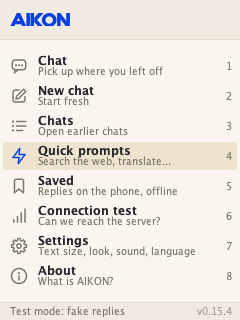
The project’s screenshots are emulator captures, and the developer identifies their test-mode replies as simulated. They show the interface rather than proof of a live AI response. The repository also links to the creator’s original Nokia demonstration.
Hosted credits or your own server
The AIKON website lists a hosted option with prepaid credit packs, starting at $4.99 for 5,000 credits as of October 27. The amount used varies with the model and message; long chats, images and web searches cost more. The site describes the service as having no subscription.
Alternatively, the self-hosting guide describes a separate server and an API key for at least one provider. That route gives the operator their own infrastructure, but hosting and model usage can incur costs. The code is open source; AIKON says it is independent of Nokia and the AI providers it connects to.
Connectivity and privacy still matter
The original 6300 needs a working mobile-data connection. Available 2G coverage varies by carrier and location, so owning the phone does not guarantee it can get online. The tested E63 is a different device: the project documents its use over Wi-Fi. Meanwhile, the 2007 6300 should not be confused with HMD’s later 6300 4G model.
There is a security tradeoff, too. The developer’s architecture notes say the 6300 uses TLS 1.0 to reach the bridge, with a private certificate installed on the phone. The IETF formally deprecated TLS 1.0; the server’s separate connection to AI providers uses modern HTTPS. The old phone-to-server link therefore remains a legacy-security compromise.
For the hosted service, AIKON’s privacy notice says messages and submitted photos go to the selected model provider. It says chats are retained for 30 days after the last message, while pinned chats remain until deleted. Self-hosted retention depends on the operator’s deployment; the project documents its own defaults.
AIKON shows what a server can do for a phone built long before today’s chatbots. Anyone considering the project still needs to weigh the network, setup, cost and data-handling tradeoffs. For another take on simple hardware, our earlier look at the Nokia 300 Charge covers a newer feature phone designed around battery life.