


















YouTube Music is rolling out AI music labels so listeners can see when a song relied primarily on generative AI. YouTube announced the change on its official blog on October 14, 2026. The labels begin “starting today,” and the company says they will later expand to the main YouTube app.
The rollout is only beginning. YouTube says the labels are “rolling out,” not that every track, listener or market has them yet. The post gives no timeline for the move to the main YouTube app.
What the listener sees
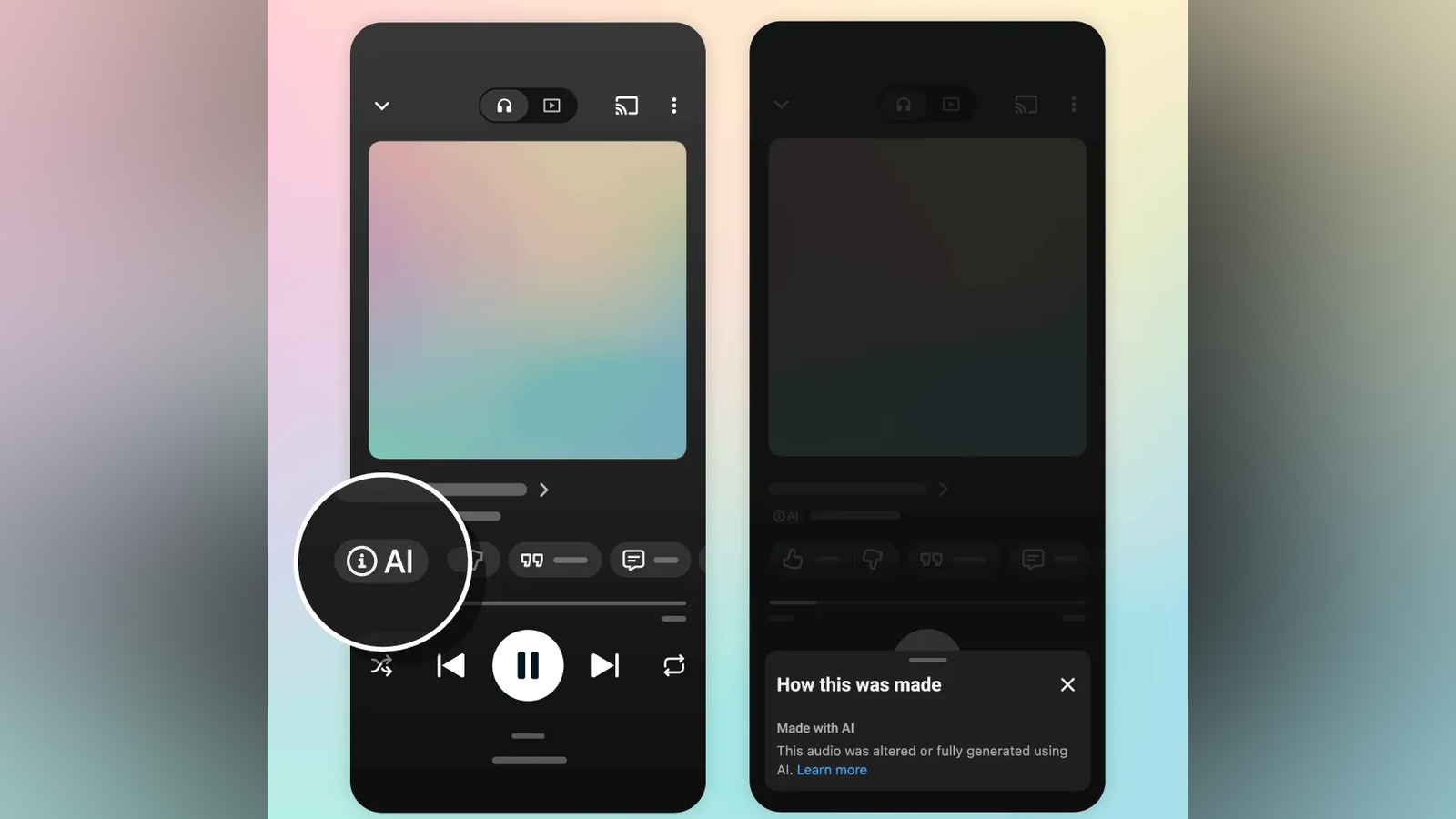
“When you listen to a track on YouTube Music where AI played a significant role, you’ll see a label directly on the player page,” YouTube wrote. “Tapping the label opens a simple menu that shares more information.”
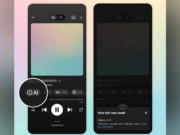
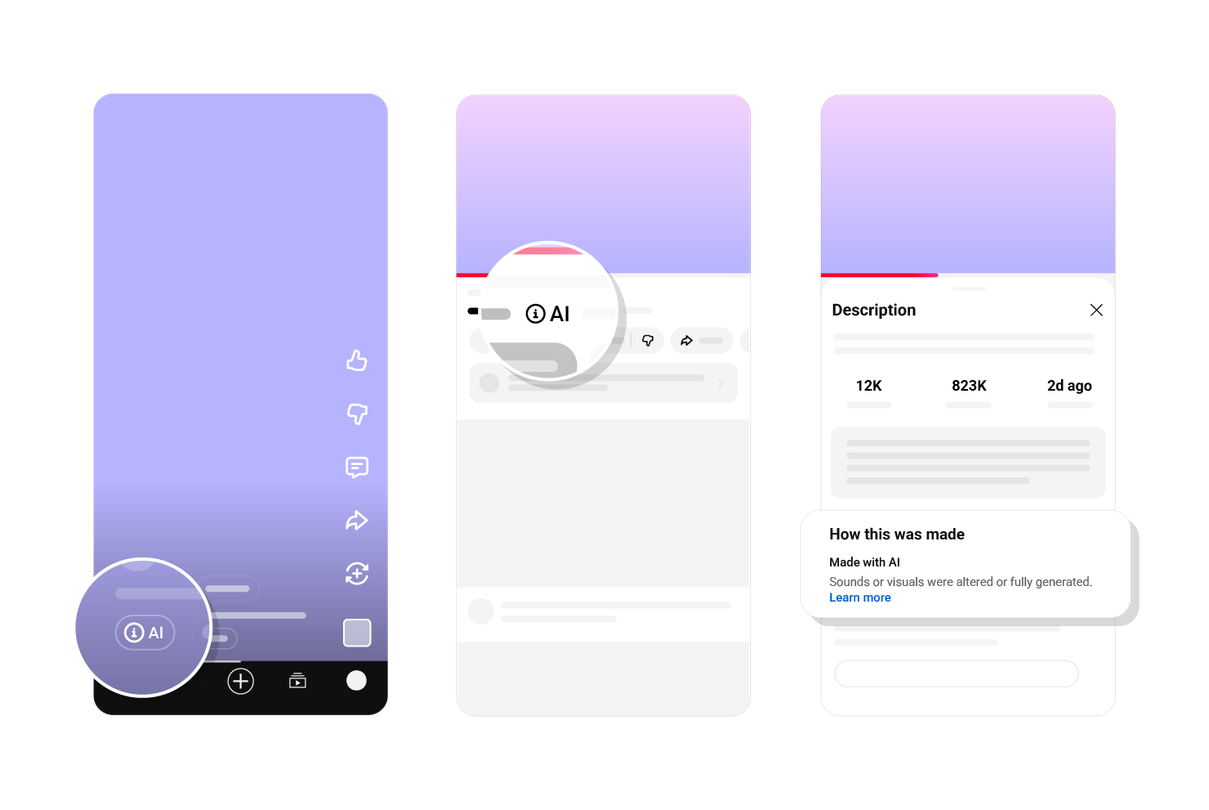
YouTube’s announcement illustration shows the label as a small pill reading “AI” in the player page’s control row, and the opened pill as a “How this was made” panel that reads “Made with AI” and “This audio was altered or fully generated using AI.” The mock uses one combined message rather than separate wording for fully and partly AI-made tracks.
Which songs get AI music labels
The announcement calls the labels a way to make it “easier to see when a song was created primarily using generative AI.” It offers one example: “using a generative model to create the composition and vocals.” A separate YouTube Help Center page for music partners sets out the categories behind the decision. Partners can declare a track “Fully Gen AI” when generative AI created all the content. “Partly Gen AI” covers content that was partly generative AI. “No Gen AI” covers content with none.
That page’s examples settle the middle category. An artist who generates a structural layer such as a bassline with AI and records their own live vocals and instruments over it falls under partly Gen AI. So does a song where AI brainstormed lyrical themes or generated melodies before the artist recorded the audio in a studio. Even a song using 100% human-performed audio counts as partly Gen AI if a text-to-video model made its accompanying music video visuals. An engineer correcting minor tuning mistakes with standard pitch-correction software such as Auto-Tune does not count. Neither does automated AI mastering software that adjusts a track’s final equalization, compression and sonic balance.
Who supplies the label
YouTube says it is “teaming up with music partners and using our own detection tools to identify AI-generated tracks, applying the same labeling principles already used across YouTube.” Partners report AI use through their delivery metadata. The options are DDEX feeds or CSV templates with a “contains_ai” field that accepts “all,” “partly,” “none” or “unknown.” Partners who upload through YouTube Studio instead mark the disclosure in the Attributes section.
A declaration is not the only input. Partners “should disclose” generative AI use, the help page states. YouTube “may use additional signals to augment partner declarations,” and if a partner supplies no value, YouTube “will interpret it as unknown unless we are able to make a determination based on other signals.”
The rules already on main YouTube
Music videos live on the main YouTube app, where YouTube’s creator rules are worded as a requirement rather than a recommendation. YouTube says it “require[s] creators to disclose AI-generated or altered content that seems realistic” in its AI disclosure policy for creators. Its disclosure list includes content that “creates music that’s the main focus of the video.” Creators who consistently skip disclosure risk action. YouTube lists a manually applied label, content removal or suspension from the YouTube Partner Program.
Since a May 27, 2026 update, YouTube applies a label automatically when a creator does not say whether AI was used and its systems detect significant photorealistic AI use. Creators can change an incorrect disclosure in YouTube Studio in most cases. Labels become permanent for content made with YouTube’s own AI tools. They also stay on content with C2PA Content Credentials and on content a reviewer labeled.
For videos, YouTube has said a disclosure label alone does not change recommendations. It also does not affect whether a video can earn money.
“Our goal is to make it as easy as possible for viewers and listeners to have the right information and clarity when it comes to the music they listen to.”
YouTube, official blog announcement, October 14, 2026
What YouTube has not said
The announcement does not specify which countries or languages the labels cover. It does not say whether the Android app, the iPhone app and the web player show the labels identically. It does not say whether YouTube Music Premium members and free listeners see the same treatment. The announcement also does not say whether the AI music labels affect recommendations or royalties.
The announcement says the tapped label “shares more information” but does not specify the exact wording. The panel text in YouTube’s illustration may therefore not be the wording a listener sees on every labeled song.
For listeners, the practical takeaway is narrow. YouTube’s AI music labels rely partly on partner declarations and partly on its own detection tools. A track without a label is therefore not proof that generative AI played no role.