
























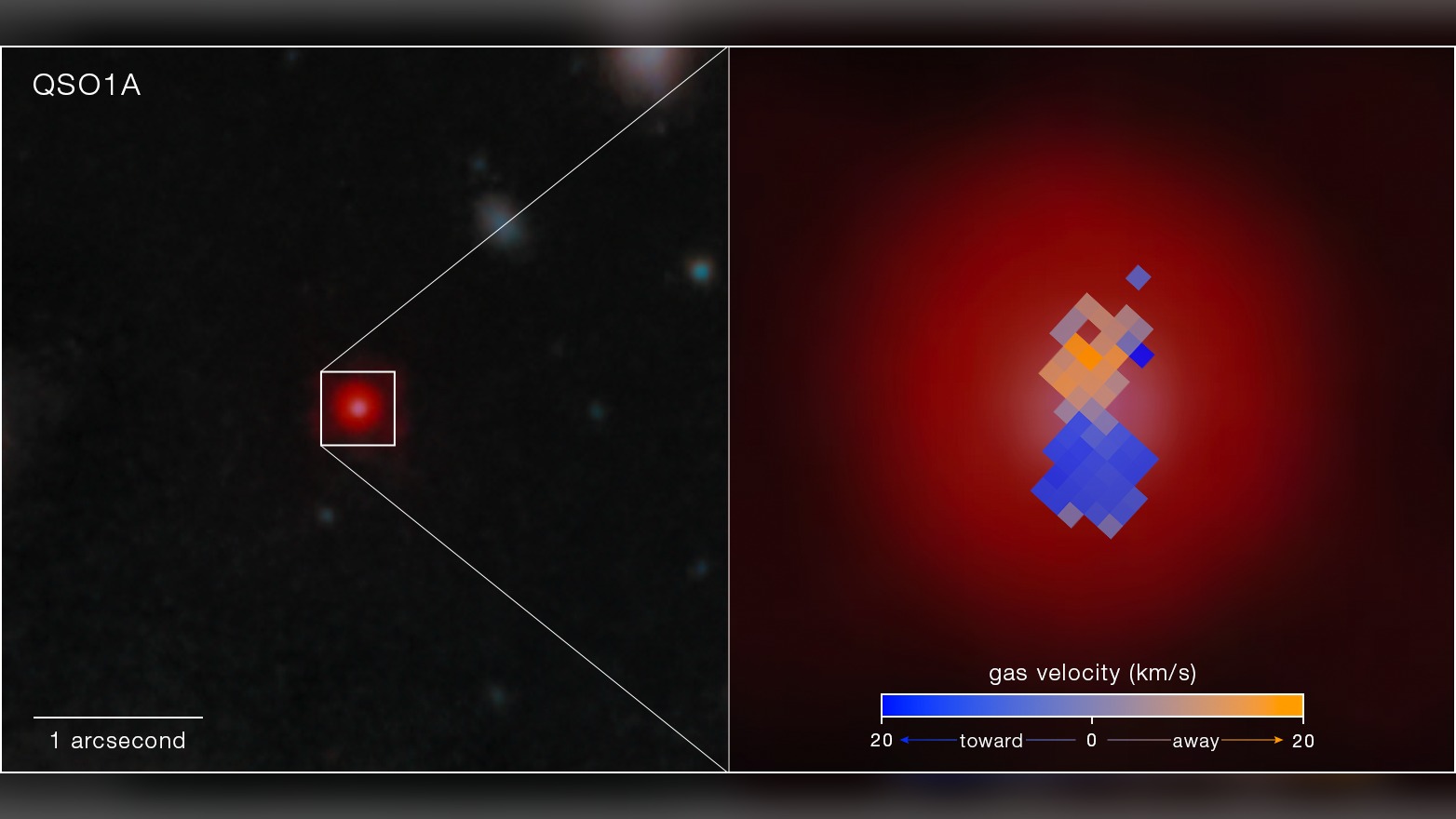
NASA’s James Webb Space Telescope has spotted a supermassive black hole that may have formed before its galaxy. The James Webb black hole finding comes from observations of Abell2744-QSO1, a tiny object more than 13 billion light-years away.
The target is one of the mysterious early-universe objects astronomers call Little Red Dots. It existed about 700 million years after the big bang.
What Webb found
Using Webb’s NIRCam and NIRSpec instruments, researchers mapped the gas moving around QSO1. The motion points to a black hole about 50 million times the mass of the Sun.
That is the strange part. QSO1 is only about 1,300 light-years across, which makes it tiny by galaxy standards.
NASA says the black hole appears to be enormous without a much larger host galaxy feeding it. That flips the usual story, where stars form first and black holes grow later from collapsed stars and mergers.
The object is easier to study because galaxy cluster Abell 2744, also called Pandora’s Cluster, acts like a gravitational lens. It magnifies QSO1 and makes it appear three times in the sky.
Why it matters
The result gives astronomers stronger evidence that some early supermassive black holes were born big. They may not need to start as small stellar-mass black holes and grow slowly over time.
One possibility is a primordial black hole, or a heavy seed that formed extremely early. Another is a direct-collapse black hole made when a giant gas cloud fell inward.
Either path would help explain why Webb keeps finding huge black holes so early in cosmic history. For more space and astronomy coverage, follow Tech My Money’s Science/Tech section.
The research was published with support from teams connected to NASA, STScI, the University of Cambridge, and other institutions. NASA says the team is now studying more Little Red Dots. The goal is to see whether this black-hole-first pattern was common in the early universe.