


Anthropic just shipped Claude Opus 5, a model it says comes close to Claude Fable 5 intelligence at half the cost per task. The company is pushing Opus 5 as the everyday default on Claude Max and the strongest option on Claude Pro.
Therefore paid users get a clearer workhorse model without jumping to Fable pricing. API pricing stays at $5 per million input tokens and $25 per million output tokens. Those match Opus 4.8 list rates.
Near-frontier coding for less
Anthropic says Opus 5 leads coding and knowledge-work evals such as Frontier-Bench and GDPval-AA. On Frontier-Bench v0.1, the company claims it more than doubles Opus 4.8 performance at a lower cost per task. On CursorBench 3.2 at max effort, Anthropic says Opus 5 sits within 0.5% of Fable 5 while cutting cost per task in half.

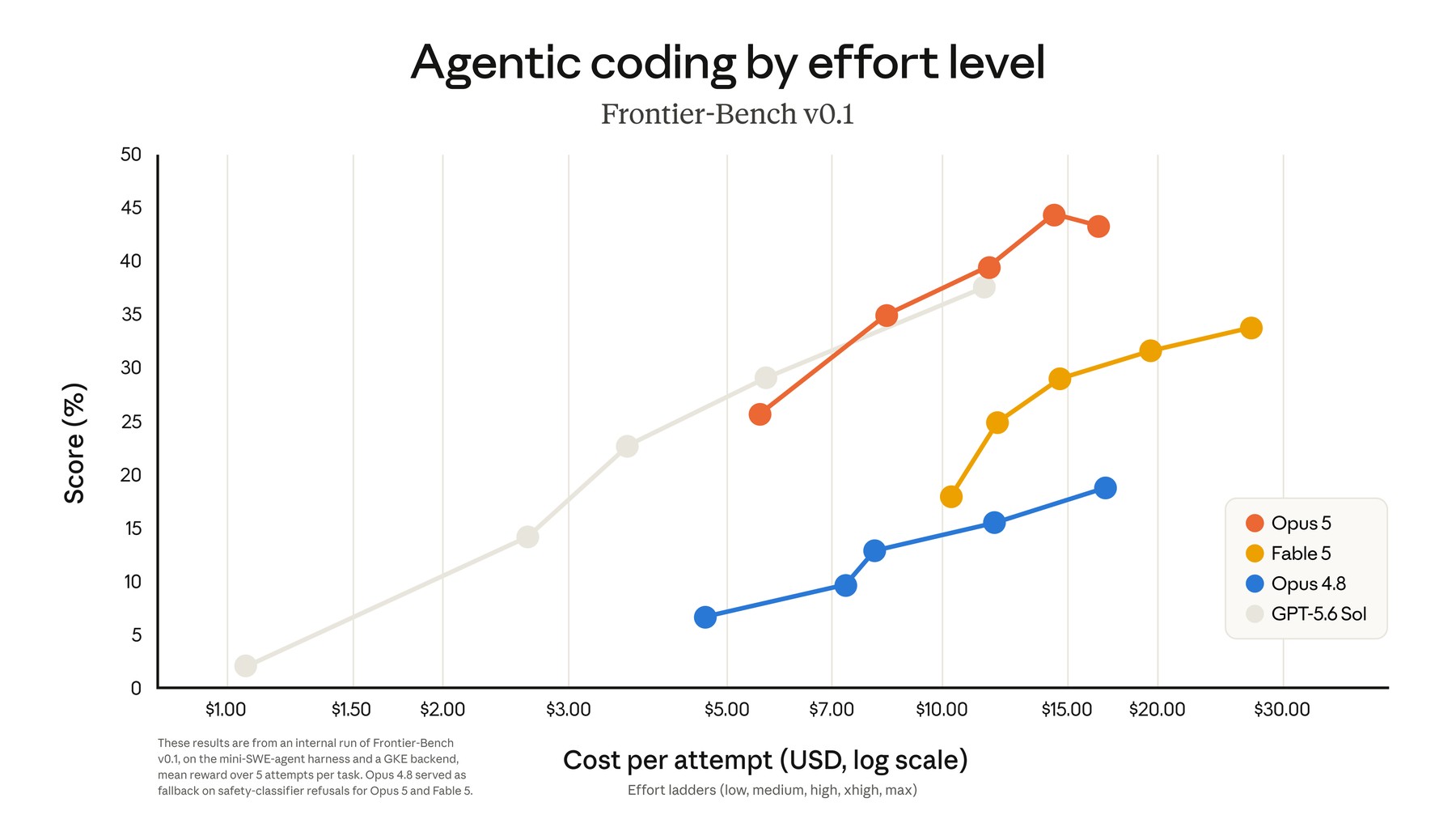
Effort controls let you trade thoroughness for speed and token spend. Anthropic also flags gains on ARC-AGI 3, Zapier AutomationBench, and OSWorld 2.0 computer-use tests. It says Opus 5 beats other models at a given cost. On OSWorld, it claims better results than Fable 5 for about one third of the cost.
Safer defaults, lighter Fable-style blocks
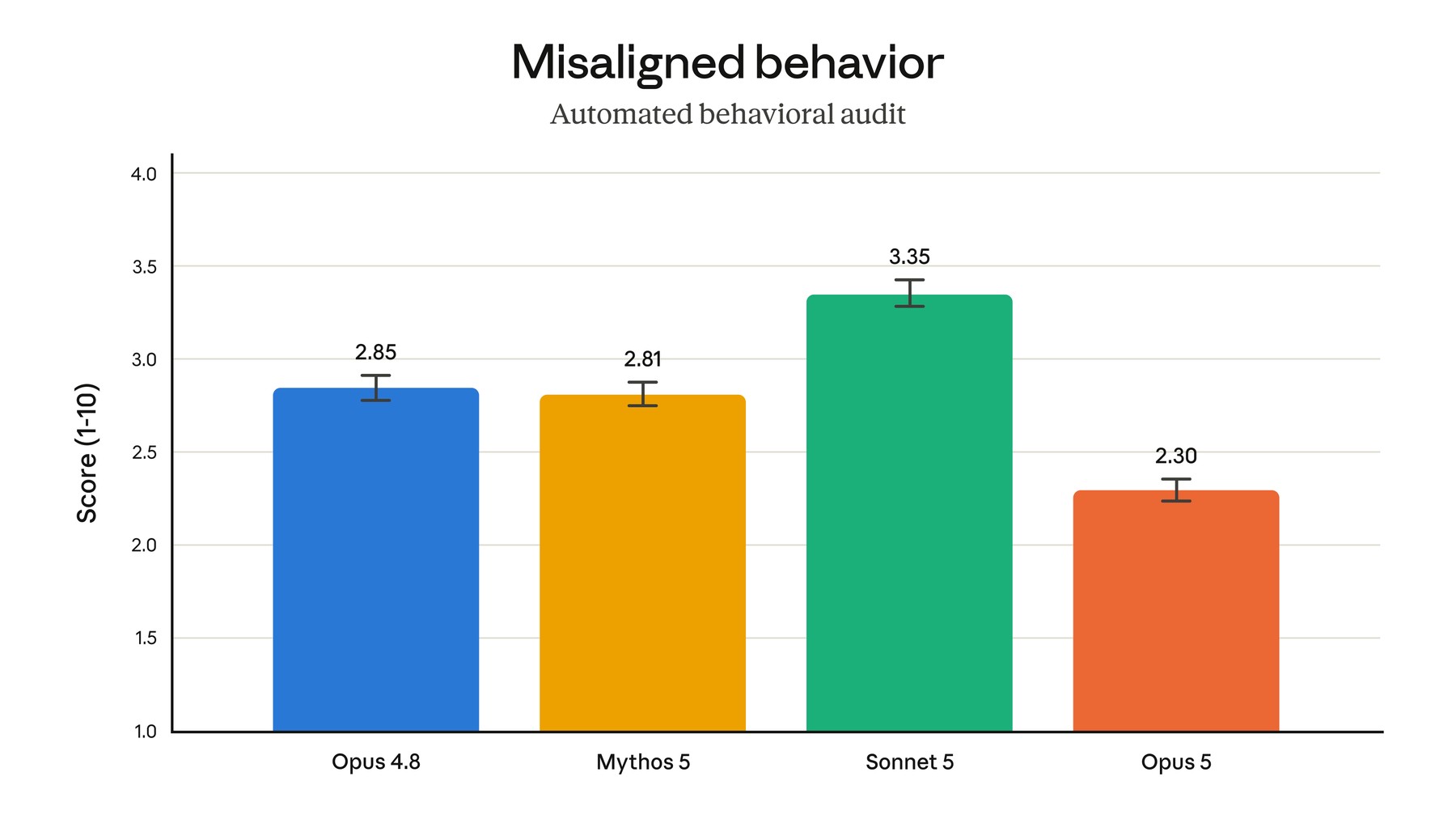
Anthropic calls Opus 5 its most aligned recent model on an automated behavioral audit. The company says it shows the lowest rates of deceptive behavior and is harder to trick into misuse. That matters for teams that bounced off Fable 5 after heavy prompt routing and refusals.
Meanwhile safeguards stay closer to Opus 4.8 than to Fable. Anthropic says cyber classifiers should intervene about 85% less often than on Fable 5. Opus 5 can help find source-code vulnerabilities. Anthropic still blocks binary vulnerability scanning, pen testing, and exploit generation for general users. Flagged requests can fall back to Opus 4.8 on Claude.ai, Claude Code, Claude Cowork, and the API.
On dual-use risk, Anthropic says Opus 5 does not set a new high-water mark. It remains behind Mythos 5 on biology research and offensive cyber. Anthropic says it did not train Opus 5 on cyber tasks. The model improved at finding vulnerabilities through general capability gains. Yet it still trails Mythos on turning those finds into exploits, per the company system card summary.
Where it ships and what changed
Claude Opus 5 is available today across Anthropic platforms. Developers call it with the claude-opus-5 model ID. Fast mode runs about 2.5 times default speed at double the base price on the Claude Platform and through Claude Code usage credits. Unlike Fable and Mythos 5, general-access Opus 5 does not add Anthropic’s 30-day data-retention requirement.
Two API betas arrive with the launch. Mid-conversation tool changes keep the prompt cache valid when tools change. Automatic fallbacks can route safety-flagged Opus 5 or Fable 5 requests to another model instead of hard-blocking. Biology blocks that once bounced Fable traffic to Opus 4.8 now route to Opus 5 instead.
Why it matters
Opus 5 is less a flashy new tier and more a price-to-performance reset. Anthropic wants daily coding, research, and agent work to land on Opus rather than forcing every hard job onto Fable. Tech My Money already covered how Claude Fable 5 moved off normal subscriptions after July 7. Separately, Claude keeps expanding as a product surface, including voice mode upgrades that now reach Sonnet and Opus models.
Still, every headline score is company-reported. Treat the half-price claim as relative to Fable task cost on Anthropic charts. It is not a guarantee versus every rival model or every real workload. If you already pay for Claude Pro or Max, check whether Opus 5 is now the default. Also check whether your workflows need Fast mode, effort sliders, or CVP-level cyber access.


