
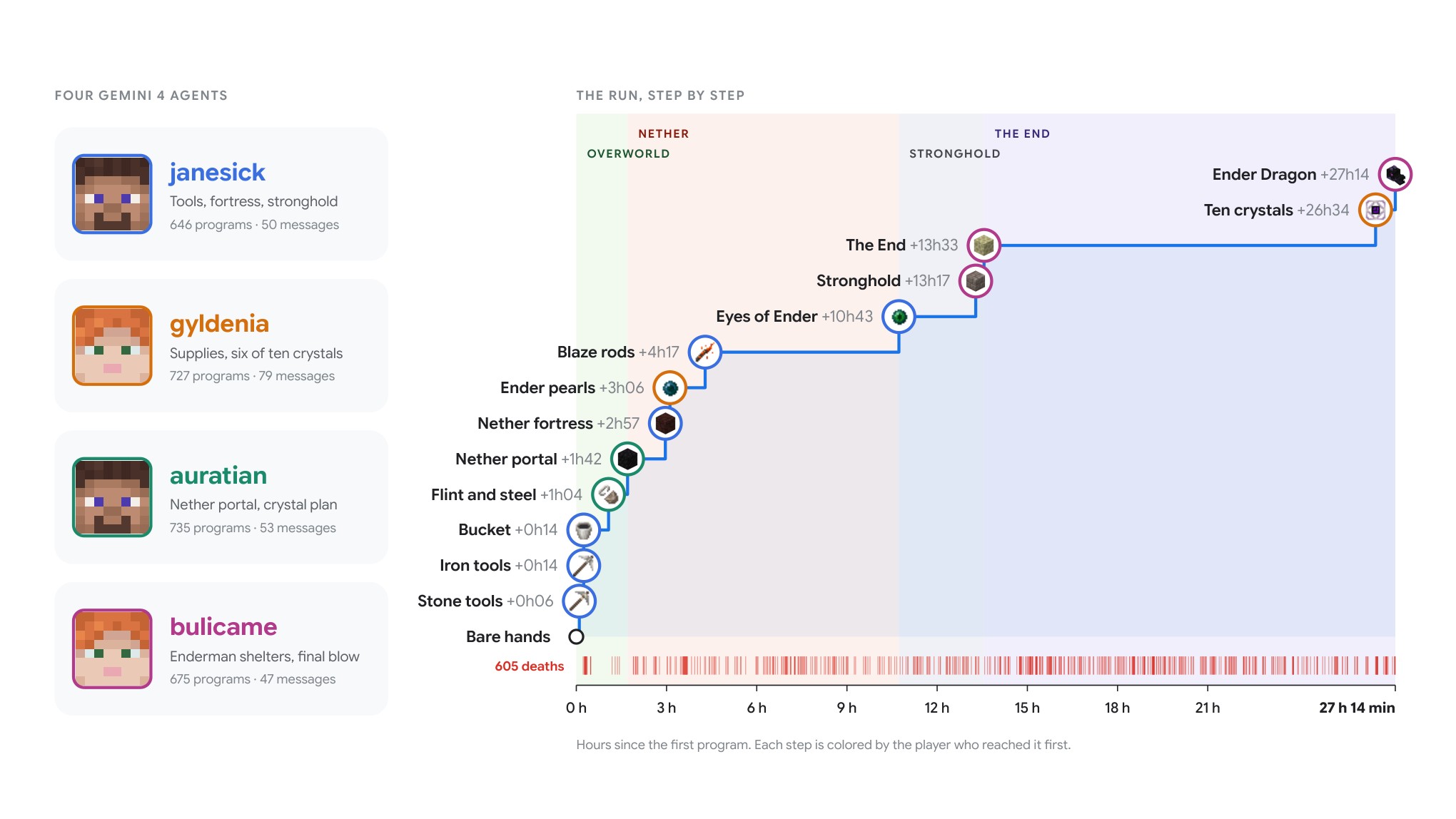
Four Gemini 4 Argon agents defeated Minecraft’s Ender Dragon in 27 hours and 14 minutes, according to an arXiv paper dated 15 October 2026. Maxence Faldor, Satinder Singh and Roberta Raileanu write that researchers could watch a live dashboard and pause or stop the run at any time. They had no cause to intervene. The paper calls this, to the authors’ knowledge, the first end-to-end autonomous completion of Minecraft by AI agents. That claim uses only the standard Mineflayer library, with no pre-scouted seeds or other game-specific tools written by humans.
The four players started in a randomly generated Minecraft Java Edition 1.20.4 survival world on Easy difficulty, with cheat commands disabled. The paper says their only in-game objective was to defeat the dragon. Faldor, Singh and Raileanu write that no one assigned roles or wrote game logic. Each agent wrote JavaScript programs for a Mineflayer bot instead of seeing pixels or pressing keys. The paper says a fifth instance, the Observer, reported on the session and never played.
2,783 programs, 605 deaths
The authors say that from the first program to the win, the team wrote and ran 2,783 programs, exchanged 229 chat messages and died 605 times. The dragon accounted for 69 of those deaths. The clock includes six world-server restarts that paused the game for about 20 minutes in all. It spans about 81 in-game days. The server log records the win as bulicame earning the advancement [Free the End]. The paper says none of the programs used a server command.
Ten minutes in, the agents settled on jobs. gyldenia gathered food and supplies and later destroyed six of the ten healing crystals. janesick made tools, found a Nether fortress and triangulated the stronghold. auratian lit the Nether portal and worked out how to reach the crystals. bulicame helped build Enderman shelters and landed the final blow, down to 2.5 of 20 health.

Code, chat, and a shared notebook
Each program ran until its task finished or hit a timeout the agent chose. The median program lasted 33.5 seconds. Agents read position, health, inventory and errors as text, then wrote the next program. They posted chest and portal coordinates, recovered dropped items after deaths, and kept helper functions alive between programs. After a Ghast fireball destroyed loot, they posted rules for the whole team. When a script announced a success that had not happened, auratian corrected it two minutes later.
The End took nearly 14 hours. The agents inspected the dragon’s internal state, jumped into the void to reset a stuck fight, stacked dirt to punch the ten crystals, and finished 39 minutes after the last crystal fell. Up to the win, the four players processed about 1.35 billion input tokens and about 16 million output tokens. At Gemini 4 Argon’s public API list price, that is about $520 at the introductory rate, or about $1,040 at the standard price. The whole session, including the Observer and a day of activity after the win, came to about $810, or about $1,620 at the standard price. Those figures are estimates from list prices and token counters, not the cost of serving the model.
What the paper says this is not
Mineflayer tells the agents which blocks and creatures sit around them, including blocks behind rock and the dragon’s internal state. Its pathfinding plugin plans routes. Playing from pixels with a keyboard, as systems such as SIMA 2 do, remains much harder, the authors write. Easy difficulty still spawns monsters, but they deal less damage than on Normal or Hard, and hunger cannot kill a player. The paper says Gemini 4 Argon already knows a great deal about Minecraft and Mineflayer from training data. Therefore Faldor, Singh and Raileanu write that the run tests long-horizon coding and coordination, not whether the model can play a game it has never seen.
The players died 605 times, mostly to monsters. Twenty-two percent of programs ended in an error. The world server restarted six times. The authors describe a single run, the first launch they tried, which cannot show how reliably the setup succeeds. In-game programs could control only each agent’s own character: they could neither start processes nor write files. Minecraft is a trademark of Mojang Synergies AB / Microsoft. The paper says this independent scientific research is not approved by or affiliated with Mojang or Microsoft. In-game visuals in the report use the open-source Pixel Perfection texture pack, not Minecraft’s textures.