
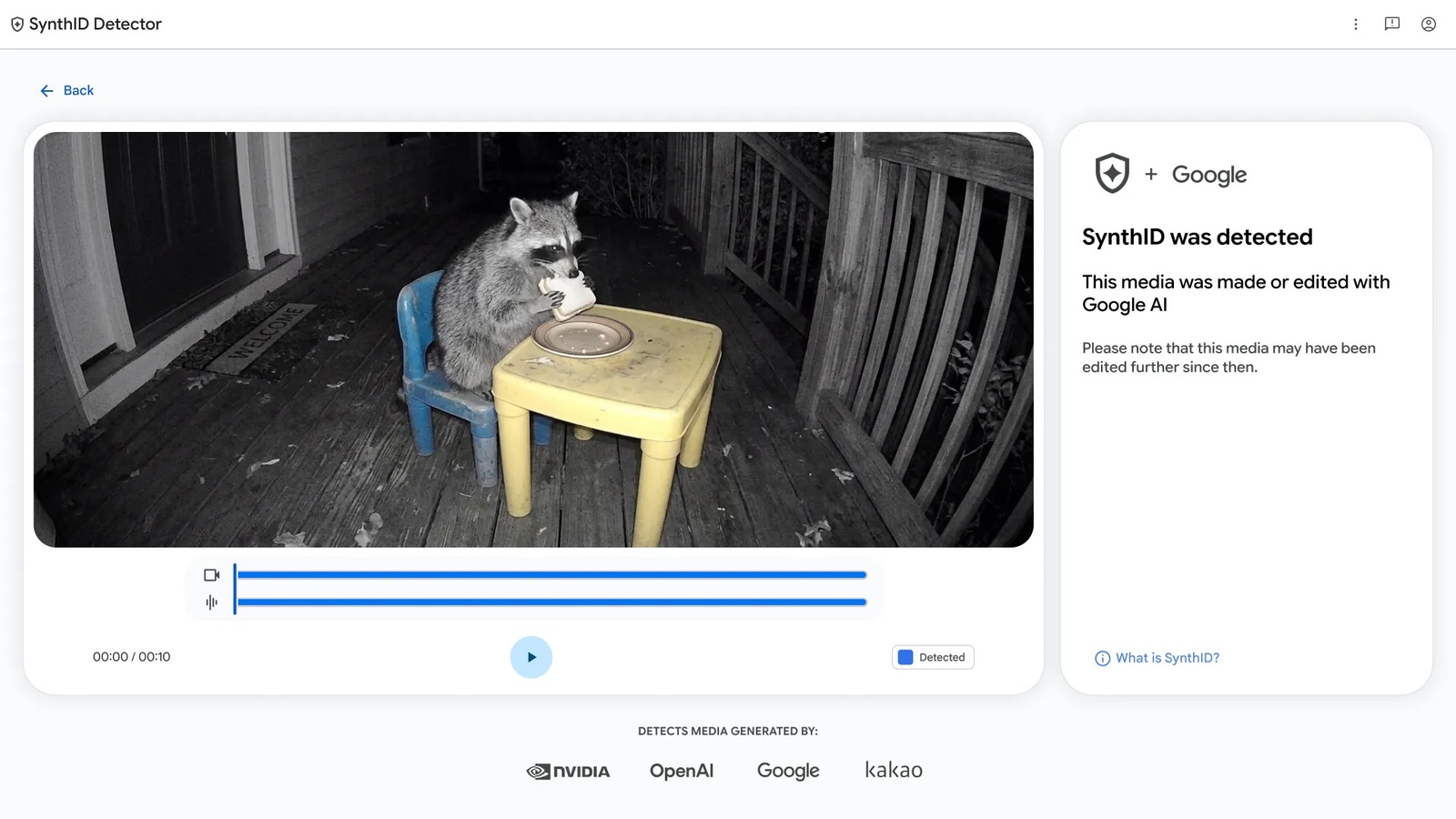
Google DeepMind has opened the standalone SynthID Detector web portal to everyone globally in English. Google first tested the portal in 2025 with journalists and media professionals. Now, the expanded verification website lets anyone check whether an image, video, or audio file carries a SynthID watermark. Beyond Google’s own AI models, the tool detects watermarks from partners OpenAI, NVIDIA, and Kakao. Support for Apple models is coming soon.
Google DeepMind Vice President Pushmeet Kohli says Google has watermarked over 180 billion images and videos since launching SynthID in 2023. Over that period, the company also watermarked 240,000 years of audio content. The web portal joins Google’s built-in provenance checks inside Search, Chrome, and the Gemini app. Those built-in tools already handle over 1 million verification requests daily alongside frontier releases like Gemini 4 Argon.
How to Check Files on SynthID.com
To scan a file, visit SynthID.com and sign in before running a check. The portal supports sign-in through a Google, Apple, or ChatGPT account. Once signed in, users pick one of three cards for Image, Audio, or Video detection. They can then upload a media file from their device.

Each media category accepts uploads up to 100MB. For example, the image scanner supports JPEG, PNG, BMP, and WebP files. Meanwhile, the audio checker accepts MP3, WAV, OGG, AAC, M4A, and FLAC tracks. The preview video scanner supports MP4, MOV, and WebM clips. After a quick scan, SynthID Detector reports whether a watermark appears in all or part of the file. Video and audio scans also highlight detected segments along a playback bar.

Watermark Durability and Detection Limits
On its SynthID technology page, Google DeepMind explains how the tool embeds imperceptible digital watermarks into pixels or audio signals at creation. Image and video watermarks withstand cropping, filters, frame-rate changes, and lossy compression. In addition, audio watermarks from Google’s Lyria music model or NotebookLM podcast generator survive noise, MP3 compression, and speed changes.

However, SynthID Detector is a watermark verifier rather than a universal AI detector. Because it only checks for SynthID signatures, it cannot flag media from non-participating AI tools. Even within partner platforms like OpenAI’s expanding AI ecosystem, a negative result only confirms that no SynthID watermark appeared. Low resolution, video below 10 frames per second, heavy tampering, or minor AI edits can also leave a scan inconclusive. Finally, the web app enforces per-modality upload quotas to prevent abuse.