


Muse Code is Meta’s new terminal coding agent, now in early beta. It is powered by Muse Spark 1.2, a coding-focused update to Meta’s Muse Spark model line. Meta published the details on its AI research blog.
Meanwhile, Muse Code targets repository-scale work. Meta says the agent can plan changes, write code, and validate results with less hand-holding. It can also run multiple persistent subagents on a task, so hard multi-step jobs finish with less steering.
How the agent is built
Muse Code uses a main agent loop plus async background agents. Those helpers stay active for the whole session, rather than spawning only for one subtask. Therefore, they avoid re-gathering the same context and can push next steps without constant prompts.
In addition, the runtime keeps a local event log. The system appends every model call, tool run, approval, and edit. After a crash, the agent can resume from the last event. That design supports long jobs that would otherwise die mid-run.
Default skills include /plan for an approval-gated plan, /grill to stress-test that plan, and /goal to drive toward a stated objective. Meta demos range from a photon-sphere scene to a vacation-home marketing page built from an MP4 walkthrough.

Muse Spark 1.2 under the hood
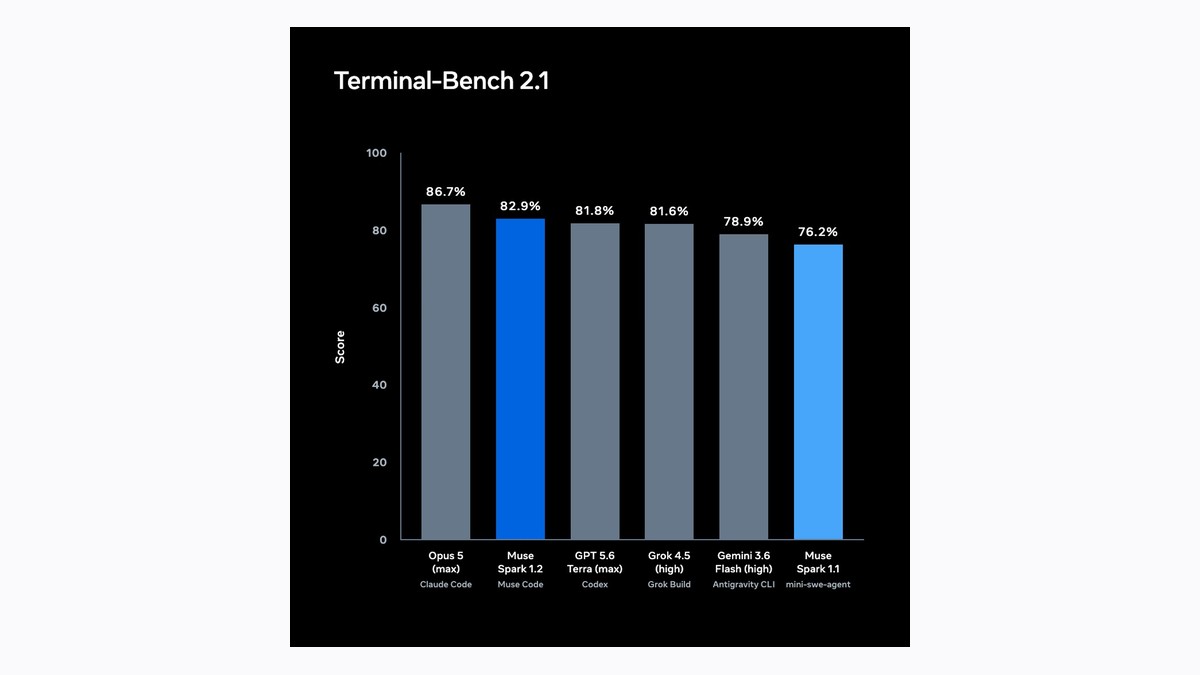
Muse Spark 1.2 is a coding-focused update to Muse Spark 1.1. Meta says the release improves code generation, complex debugging, codebase understanding, and end-to-end developer workflows. The company also co-trained the model with Muse Code so the pair works as a matched harness.
Training stressed long-horizon tasks, whole-repository generation, and large end-to-end projects. Still, Meta keeps broader agent skills in the mix. Benchmark charts on the research page compare Terminal-Bench, DeepSWE, and internal coding scores against other coding models.
Availability, install, and pricing context
Muse Spark 1.2 is available today in Muse Code and through the Meta Model API with expanded global access. On macOS or Linux, Meta’s install path is a single curl script from dev.meta.ai. Overall, the product sits next to rivals like Claude Code and OpenAI’s coding agents in a crowded terminal niche.
Token pricing is not spelled out on the Muse Code blog itself. According to Engadget’s report of Meta’s default rates, Muse Code follows Muse Spark pay-as-you-go pricing at $1.25 per million input tokens and $4.25 per million output tokens. Separate CNBC and Wall Street Journal interviews with Meta leadership describe a lower-cost contributor tier that requires feedback.
Tech My Money has already covered how Meta’s Muse Image turns Instagram accounts into AI prompts and how OpenAI’s Codex Micro keypad targets coding-agent control. Muse Code is Meta’s clearest bid for that same developer workflow battle, with a beta install path open now.


