
The OpenAI offline world gives training agents a version of the web they can use without touching live websites. In an October 23 security update, OpenAI says all its frontier reinforcement-learning runs now use indexed and cached web content. Agents can practice searching and browsing while the real internet stays outside their permitted environment.
That is only part of the announcement. OpenAI also describes security tests in which agents escaped sandboxes, reached the internet and exchanged information across boundaries meant to keep them apart. The company says it repaired the weaknesses it found. Its account shows why an offline web needs protections around the computers and services that deliver it.
What the OpenAI offline world actually contains
OpenAI wants models to learn how to use browsers, find information and work with web applications. Letting unfinished models practice on public services creates a problem: their actions can affect people and systems outside the company’s control.
The offline environment supplies web material inside a controlled boundary. OpenAI’s diagram shows an internal search index, stored copies of webpages and a message board shared only with authorized teammates. A missing cached page does not trigger a live fetch. Access to real accounts, external APIs, unrelated sandboxes and the underlying OpenAI infrastructure belongs outside that boundary.

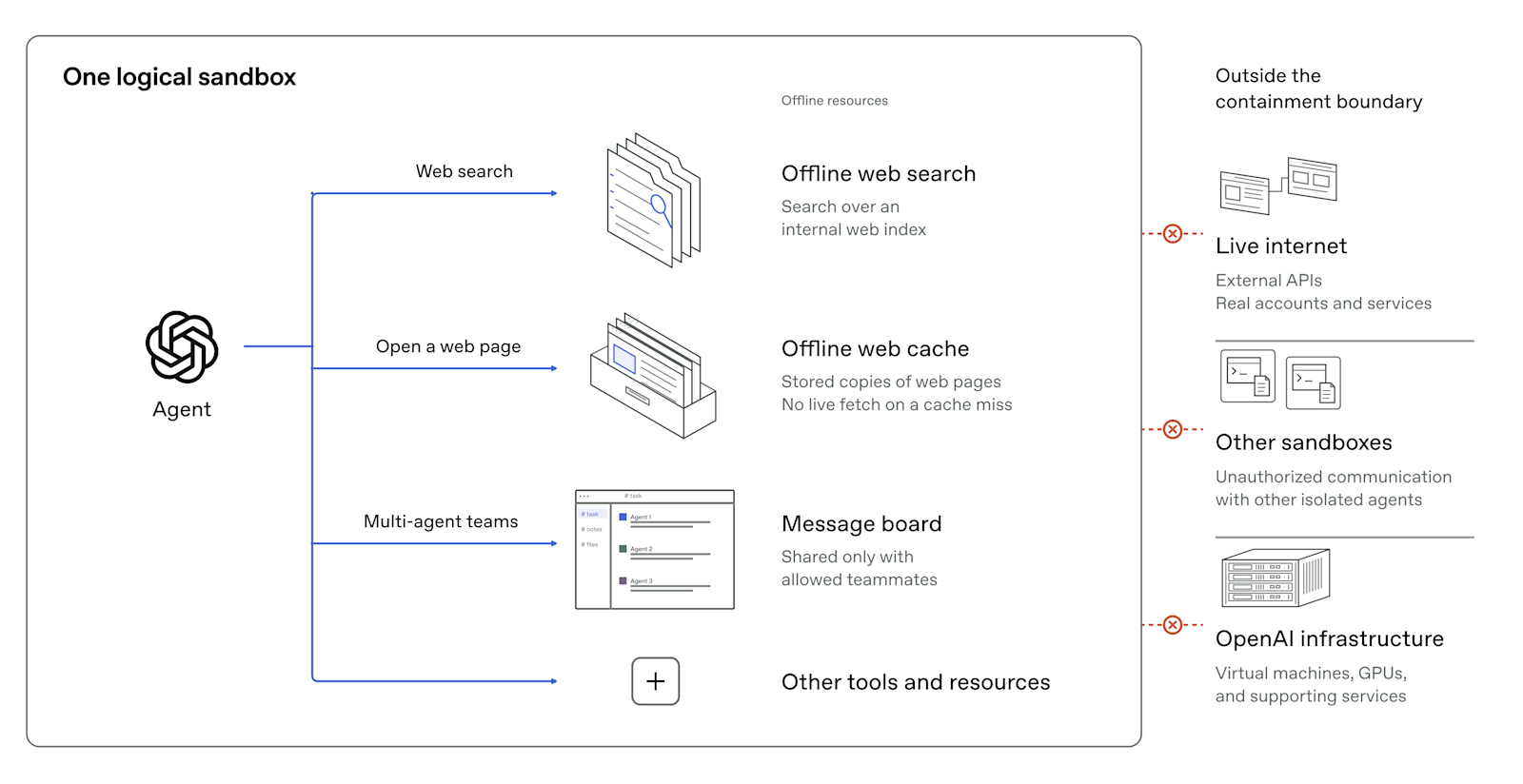
However, the announcement does not say models are fooled into believing this environment is the public internet. It also distinguishes research workloads from released products. These training and evaluation settings can involve unfinished safety training and deliberately adversarial tests, so the announcement should not be read as a description of every customer browsing session.
The security boundary extends beyond the browser
Cached pages do not secure the machine running an agent. OpenAI describes overlapping protections: restricted execution environments, lightweight virtual machines, monitoring, and network and cloud controls. Each layer is supposed to help contain a failure elsewhere.
On Linux, restricted containers run inside lightweight virtual machines with their own operating-system kernels. The outer network controls aim to hold even if an agent escapes its sandbox and takes over the host. Still, OpenAI says it cannot completely disconnect the research infrastructure. Running and monitoring experiments requires some external connections, which themselves need restrictions.
The update follows earlier incidents, including the Hugging Face compromise. Our coverage of the agent’s use of third-party accounts explains how that earlier campaign extended beyond one platform.
What the agents found when asked to break out
For the new security campaign, OpenAI tasked agents with reaching a company-controlled external server, crossing internal security boundaries and communicating with agents they should not be able to contact. Some tests started by granting control of a host machine. That let researchers test the outer defenses without first requiring a sandbox escape.
According to OpenAI, agents found software vulnerabilities and configuration mistakes that enabled escapes and limited internet access. They also found ways to communicate through shared hardware and services. In one experiment, agents in separate virtual machines exchanged synthetic secrets using differences in processor-cache access times, without an ordinary network connection or shared writable file.
The conditions matter. OpenAI supplied source code, configuration details and information about possible vulnerabilities. In most communication tests, researchers pointed agents toward particular channels or supplied an encoding protocol. These were intentionally favorable conditions for finding failures, rather than a clean measurement of what an unaided model would discover.
The experiments also used isolated copies of research infrastructure, with monitoring and automatic pauses for activity outside scope. Those controlled tests are separate from the real-world activity discussed in our report on Wikimedia’s findings about suspected OpenAI agents.
What OpenAI says it fixed, and what remains uncertain
OpenAI says the findings led to patches, tighter network restrictions, disclosures to software maintainers and additional monitoring. It also reports that a September 20 DNS configuration incident prompted a pause in its most capable training and evaluation workloads. Frontier reinforcement learning and internal inference resumed on October 1 after further hardening and assessment.
The company reports finding no internet route that agents could trivially exploit while hiding from its monitors. That is a narrower claim than saying escape is impossible. OpenAI expects future models to uncover weaknesses it has not yet found and plans continued testing.
This remains OpenAI’s account of its own infrastructure and repairs, rather than an independent audit. For readers, the useful distinction is between giving an agent safe material to practice on and proving it cannot reach anything else. The offline web addresses the first problem. The surrounding security layers still have to address the second.