






















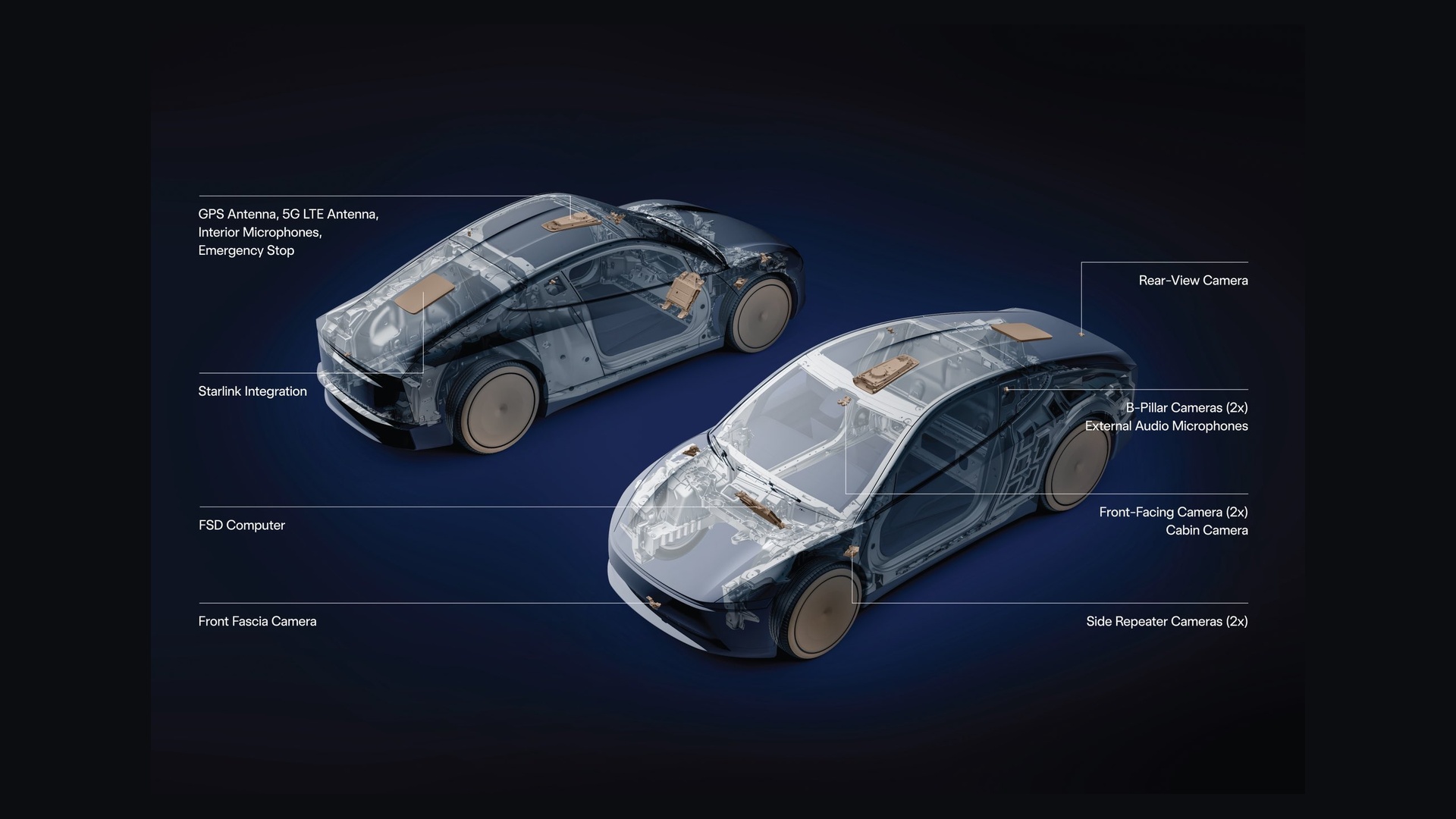
Tesla Cybercab is getting a built-in Starlink V5 antenna. Tesla posted a cutaway on July 20, 2026. The company wrote that Starlink V5 is “directly integrated in Cybercab.” The graphic shows the antenna in the roof stack next to GPS and 5G LTE hardware.
Starlink framed the same graphic as high-speed internet from space for autonomous vehicles. Therefore, the tease is not a third-party rumor. It is a dual Tesla and Starlink confirmation of roof-level satellite connectivity on the robotaxi design.
What the Tesla Cybercab cutaway shows
Tesla’s diagram labels a Starlink Integration block in the roof. Nearby callouts include a GPS antenna, 5G LTE antenna, interior microphones, and an emergency stop. In addition, the graphic maps the Full Self-Driving computer. It also maps the camera suite: front fascia, front-facing, B-pillar, cabin, rear-view, and side repeater cameras.
In short, Starlink sits inside the vehicle architecture. It is not a bolt-on luggage-rack dish. The integration sits with other connectivity and sensing hardware a driverless fleet would need for navigation, remote support, and fleet management when cellular coverage thins out.
Starlink V5: smaller dish, home-class specs
The integrated unit is Starlink’s V5 home dish, announced shortly before the Cybercab posts. Starlink markets V5 as a smaller, lighter, more power-efficient home terminal. Public specs put peak downloads in the 375+ Mbps class. That sits a notch under the prior V4 home dish’s 400+ Mbps class, while improving efficiency and install size.
However, Starlink still describes V5 primarily as home internet hardware. That is a real tension for a robotaxi that is designed to move. Meanwhile, Cybercab also gets GPS and 5G LTE on the same cutaway. As a result, satellite is a third path rather than the only pipe. The practical pitch looks more like redundancy and fleet connectivity than a claim that V5 alone replaces urban 5G.
Why Tesla Cybercab still wants space connectivity
City robotaxi routes often sit on dense cellular networks. Still, a satellite path can help when a vehicle leaves strong 5G. It can also help with remote assistance or fleet telemetry after a ground-network failure. For example, navigation updates and support sessions can use an independent link even if unsupervised driving stays vision-first.
Primary posts
Overall, the announcement deepens the Tesla-SpaceX product overlap. It still leaves open hard operational questions: in-motion performance, rules for residential-class terminals in vehicles, fleet service pricing, and when production Cybercabs ship with the hardware. For related context, Tech My Money covered the Starlink V5 home dish launch and Tesla’s Model Y Long Wheelbase U.S. push.