
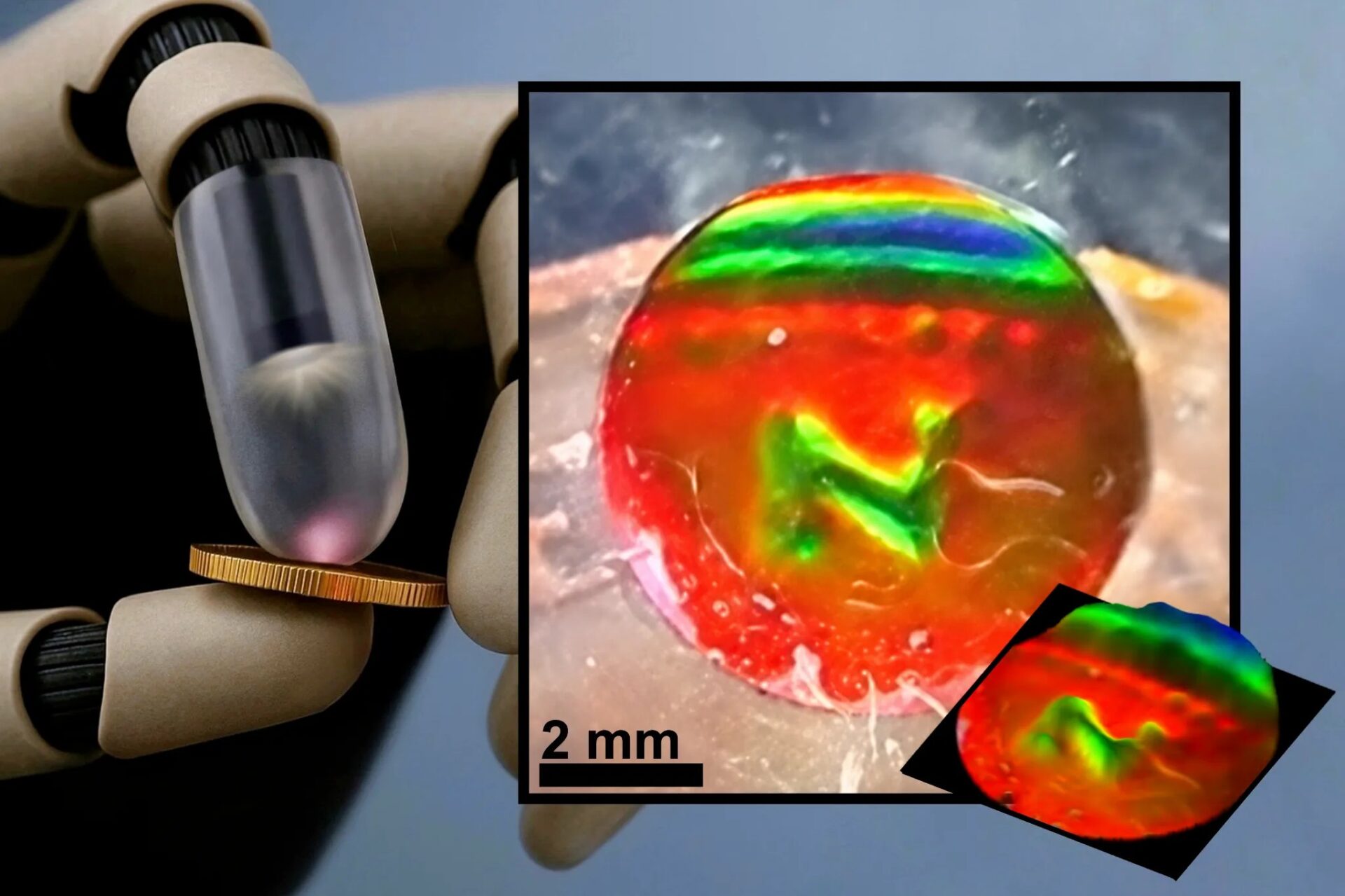
A new tactile sensor lets robots literally watch themselves feel. Researchers at Queen Mary University of London built a soft material that changes color under pressure. Point a cheap USB camera at it, and the robot gets an instant, high-resolution map of exactly what it is touching. The work was published in Science Advances on July 3.
The invention comes from Dr Giacomo Sasso, a postdoctoral researcher at Queen Mary’s School of Engineering and Materials Science. Additionally, the project pairs Professor James Busfield at Queen Mary with Professor Federico Carpi at the University of Florence, combining materials science with soft robotics.
Sensing Moves Into the Material Itself
Most robotic touch systems bury thousands of tiny electronic sensors in a fingertip. Instead, this approach makes the material do the work. The team’s mechanochromic surface converts force into shifting structural colors. Press a coin against it, and the coin’s ridges appear as vivid color patterns, sharp enough to match the fine detail of human fingertip ridges.
“The key idea behind this project was to think outside the box,” Sasso said. “Instead of embedding dense and overengineered sensor arrays, sensing is moved into the material itself.” As a result, there are no wires to route and no fragile electronics at the contact point.
No Algorithms, Just Light
Vision-based touch sensing usually needs heavy reconstruction algorithms to turn camera frames into pressure data. Here, however, the color IS the data. “What is particularly powerful is that the information is already in the light signal,” Busfield said. “You are no longer reconstructing touch. You are observing it directly.” Consequently, an ordinary low-cost camera delivers real-time maps of contact, strain, and pressure.
From Factory Grippers to Surgical Robots
The researchers point to three early applications. First, factory grippers could assemble tiny components with finer control. Second, prosthetic limbs could relay richer touch feedback to their users. Third, surgical robots could tell healthy tissue from abnormal tissue by feel. Still, this remains lab-stage research, and the team has not yet announced commercialization plans or durability data for real-world use.
Robotic touch is having a moment more broadly. For instance, a three-armed AI-trained sashimi bot already handles delicate slicing work that depends on force control. Meanwhile, researchers keep finding ways to read signals without invasive hardware, as Meta’s Brain2Qwerty typing decoder showed on the neural side. If touch really can become something robots simply watch, the cheapest webcam might end up being the best fingertip in the lab.