

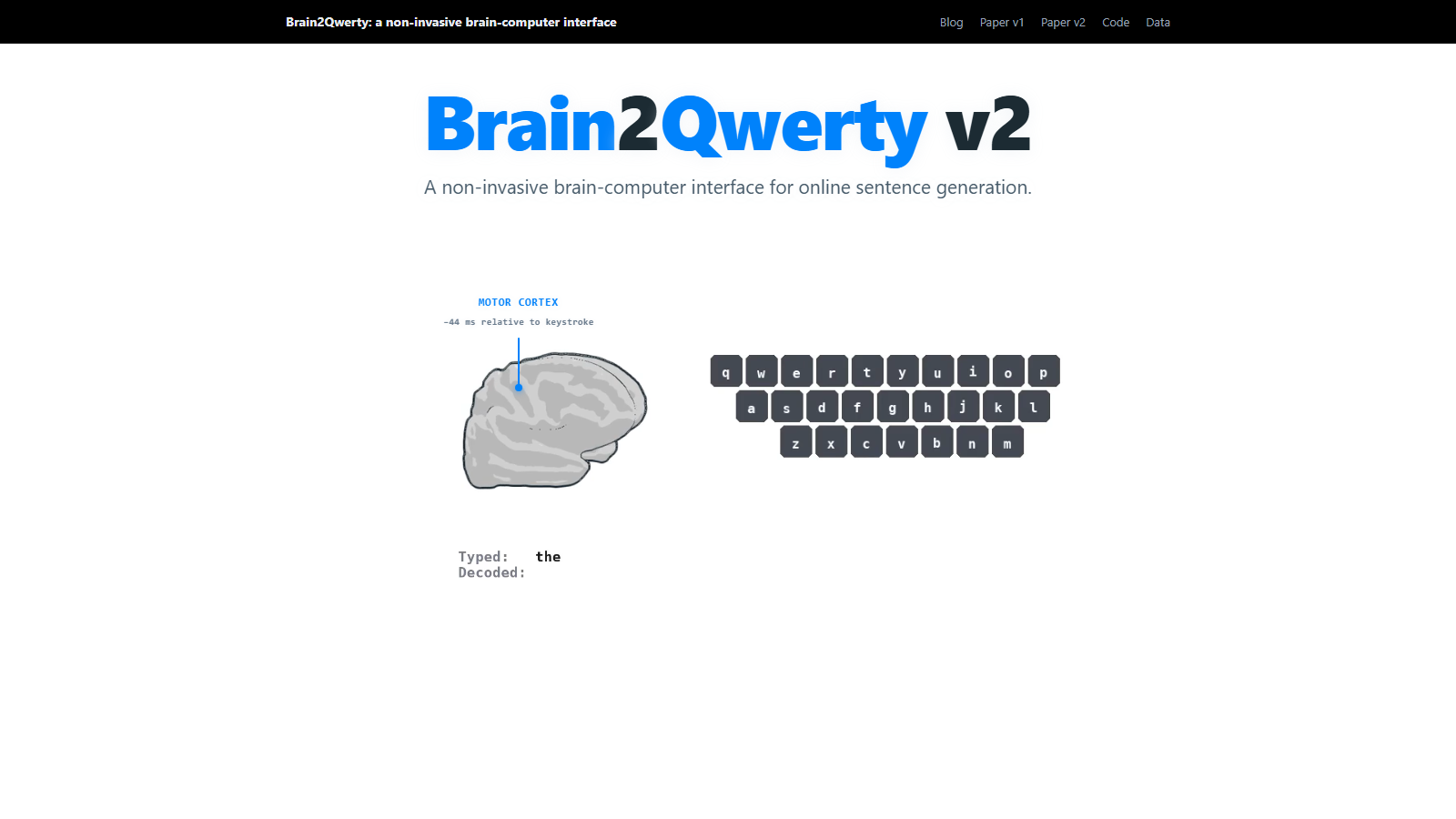
Brain2Qwerty v2, a new Meta AI and Facebook Research project, can turn non-invasive brain recordings into typed sentences with far better accuracy than its earlier version. However, the caveat matters. This is still lab research built around magnetoencephalography, not a wearable product or a ready-made communication tool.
Meta says the system decodes natural sentences from MEG recordings while a person types, without using implanted electrodes. In the v2 paper, researchers describe about 22,000 typed sentences from nine healthy volunteers. Each participant was recorded for roughly 10 hours at the Basque Center on Cognition, Brain and Language. As a result, the model has much more participant-specific data than the first Brain2Qwerty release.
What Meta Actually Demonstrated
The headline number is strong for a non-invasive setup. Brain2Qwerty v2 reached a 39 percent average word error rate across participants. The best participant landed at 22 percent WER. Meta’s project page also summarizes that result as up to 78 percent word accuracy for the best participant. Meanwhile, the earlier Brain2Qwerty v1 system could predict keystrokes from MEG patterns. However, it needed the timing of each keypress. The new model works from a continuous recording of brain activity, which is closer to how an assistive system would need to operate in real time.
That does not mean the system is reading free-form thoughts. Specifically, volunteers listened to sentences, waited, and typed the corresponding text. MEG sensors captured brain activity during the language-production and typing phase. Therefore, the result is brain-to-text decoding from a controlled typing task, not a general-purpose mind-reading interface.
How The System Gets From MEG To Words
Brain2Qwerty v2 combines three levels of modeling. First, an encoder extracts character-level representations from the MEG signal. Next, an aligner groups brain-derived embeddings with word-level representations. Finally, a fine-tuned language model generates the decoded sentence. In other words, the model is not simply matching one brain signal to one key. It uses character, word, and sentence context to recover a plausible sentence from noisy non-invasive recordings.


The paper says the model improves sentence-level communication metrics against an encoder-only baseline and an encoder plus N-gram baseline. However, it also notes a trade-off. Language models can make outputs more fluent. When the neural signal is too noisy, they can also produce fluent sentences that are simply wrong. That distinction matters for assistive communication. For a casual phrase, a semantically close sentence might help. For a password, medical request, or emergency message, exact character-level accuracy matters more.
Why It Is Still Far From A Product
The biggest practical barrier is the hardware. The study used a 306-sensor cryogenic MEG system, which is closer to a lab scanner than a consumer headset. Additionally, the participants were healthy adult volunteers. They were not patients who had lost speech or motor function after injury. Meta’s own project page says two major challenges remain. Accuracy is not yet good enough for everyday use, and the scanner setup is not accessible to most patients.
Still, the research is worth watching because it points toward a safer alternative to implanted brain-computer interfaces. Invasive BCIs have already shown impressive communication results, but they require surgery. If non-invasive sensors improve, larger datasets could close some of the gap. Moreover, the paper points to wearable optically pumped MEG sensors as one possible path toward a clinical setup.
The AI Angle Inside The Research
There is also a second AI story inside the paper. The researchers used autonomous coding agents during the optimization process. Then they compared those agent-discovered configurations with a more traditional Optuna search. According to the paper, the agent-derived configurations improved word error rate across subjects. They helped because the agents changed parts of the codebase that a four-parameter search could not reach. That makes Brain2Qwerty v2 both an AI neuroscience story and an example of AI systems being used to improve research tooling.
For Tech My Money readers, the honest takeaway is this: Brain2Qwerty v2 is a meaningful step for non-invasive brain-computer interfaces, but it is not a finished assistive device. It shows that more data, better model architecture, and better sensors may make non-invasive brain-to-text systems more realistic. Meanwhile, Meta is also exploring adjacent input ideas, from finger-movement typing on Meta Ray-Ban Display to immersive software like the native Discord app on Meta Quest. Brain2Qwerty v2 sits at the research end of that spectrum, where the promise is real, but the engineering path is still long.