
On its November 2, 2026 Swift blog, NASA says the Neil Gehrels Swift Observatory is expected to re-enter Earth’s atmosphere on Wednesday, Nov. 4, almost 22 years after launch.
The page shows a last update of Nov. 3, 2026. However, that update still presents the timing as a prediction.
A window, not a confirmation
As of Monday, the U.S. Space Force predicted that the roughly 3,200-pound spacecraft will re-enter at approximately 3:30 a.m. EST on Nov. 4. The same sentence also adds an uncertainty of 11 hours. So 3:30 a.m. is the center of a window, not a report that Swift is already down.
NASA expects most of the spacecraft to burn up in the atmosphere. NASA also expects some components to survive. Where those pieces land can change from one hemisphere to the other, and the place depends on the re-entry time.
Because of Swift’s low inclination, surviving fragments stay in a band between 20.6 degrees south latitude and 20.6 degrees north latitude. NASA calls the risk of harm to anyone on Earth unlikely, at approximately 1 in 2,100.
NASA and the Space Force will continue to monitor the re-entry and update predictions. This notice does not say the observatory has re-entered.
What Swift spent two decades doing
At launch, Swift was a first-of-its-kind multiwavelength observatory. It used three telescopes to study the most powerful explosions in the cosmos.
NASA launched Swift in 2004 to explore gamma-ray bursts. The design called for a two-year prime mission. Science operations then ran for more than two decades.
Swift watched a wide range of light, turned quickly toward short-lived outbursts, and sent alerts so other observatories could follow up. NASA says that record covers active galaxies powered by supermassive black holes, stars undergoing X-ray flares, supernova explosions, and comets and asteroids in our solar system. However, the re-entry post gives no tally of those events.
Artwork, and an earlier rescue launch
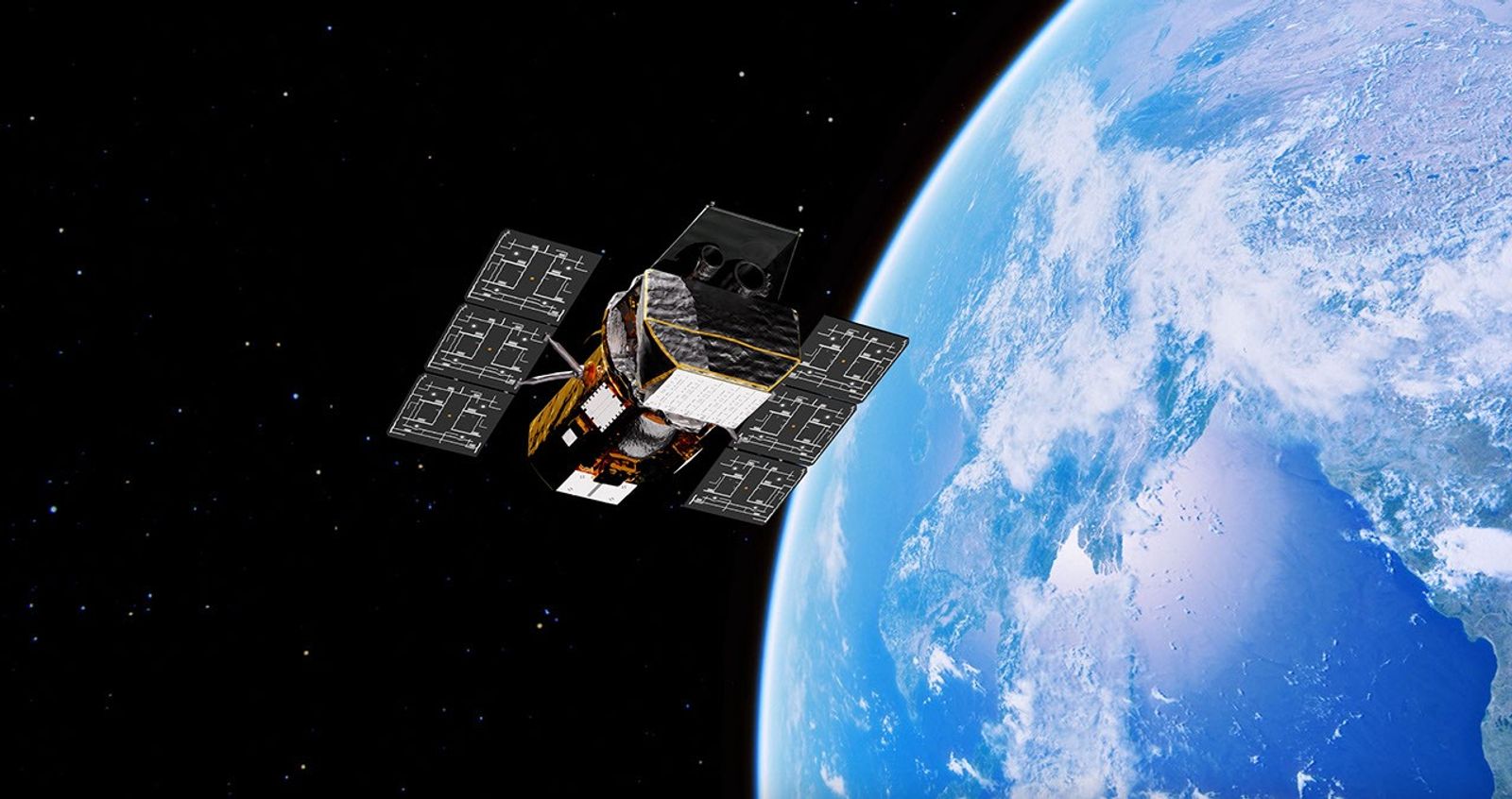
The artwork on the post shows a gold-and-black spacecraft with solar arrays stretched out, above the curve of a blue Earth. Black space fills the other side of the frame. The image is spacecraft art. It does not show a re-entry.
In July, NASA's Swift rescue mission launched to save a falling space telescope. However, this re-entry notice does not describe the result of that mission.