

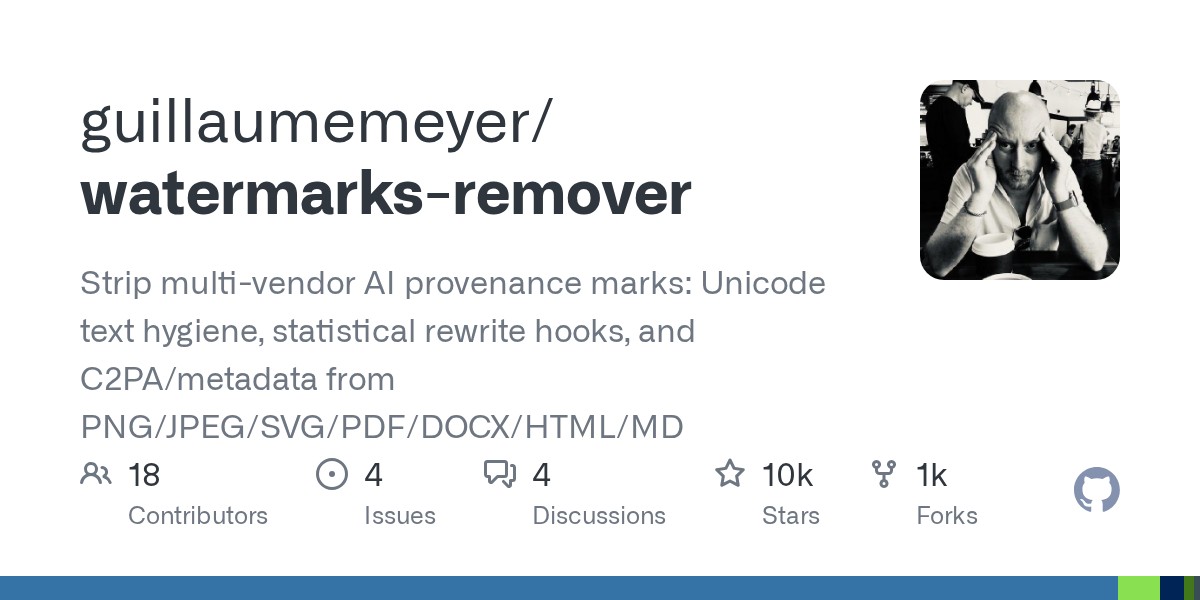
watermarks-remover is a public GitHub tool that strips AI provenance marks from text and files you own. Guillaume Meyer’s repo says it targets Unicode hygiene, statistical text marks, and file metadata such as C2PA, EXIF, and XMP. The latest tagged release is v0.5.0. The README is blunt. It cannot certify that a vendor detector will fail.
What the repo actually claims
The project splits the work into layers. Layer A strips invisible Unicode, odd spaces, and similar edit marks. Then Layer B tries to break statistical watermarks by rewriting the text. A file layer drops C2PA and other provenance data from PNG, JPEG, WebP, SVG, PDF, DOCX, ODT, HTML, and Markdown. The docs name Claude, Gemini / SynthID-Text, OpenAI provenance surfaces, and Kirchenbauer-style open-LLM marks as class-level targets.
However, Meyer is not selling a magic eraser. The README says statistical marks live in the wording itself. Therefore, a real Layer B pass has to reword a lot of sentences. That rewrite replaces premium-model phrasing with the rewriter’s phrasing. “If the plan is to rewrite the text with a cheaper model anyway, why pay for a premium model in the first place?”
What it still cannot do
Still, the official ethics page says the tool is for privacy and research on content you own. It is not for academic fraud or false “human-written” claims. Specifically, the coverage matrix leaves training backdoors out of scope. Pixel-level image marks need optional external backends. Soft-bound C2PA that can reattach after a metadata strip stays out of scope. Until vendors ship public detectors and keys, no tool can honestly certify this fails the official check.
Meanwhile, AI labels keep arriving from the other side. TMM already covered Claude’s text watermark and Gemini’s visible-mark toggle. As a result, watermarks-remover is a sign of the cat-and-mouse, not a proof that provenance is dead. Treat it as a local hygiene project with honest limits. Do not treat it as a way to pass an AI detector.


