

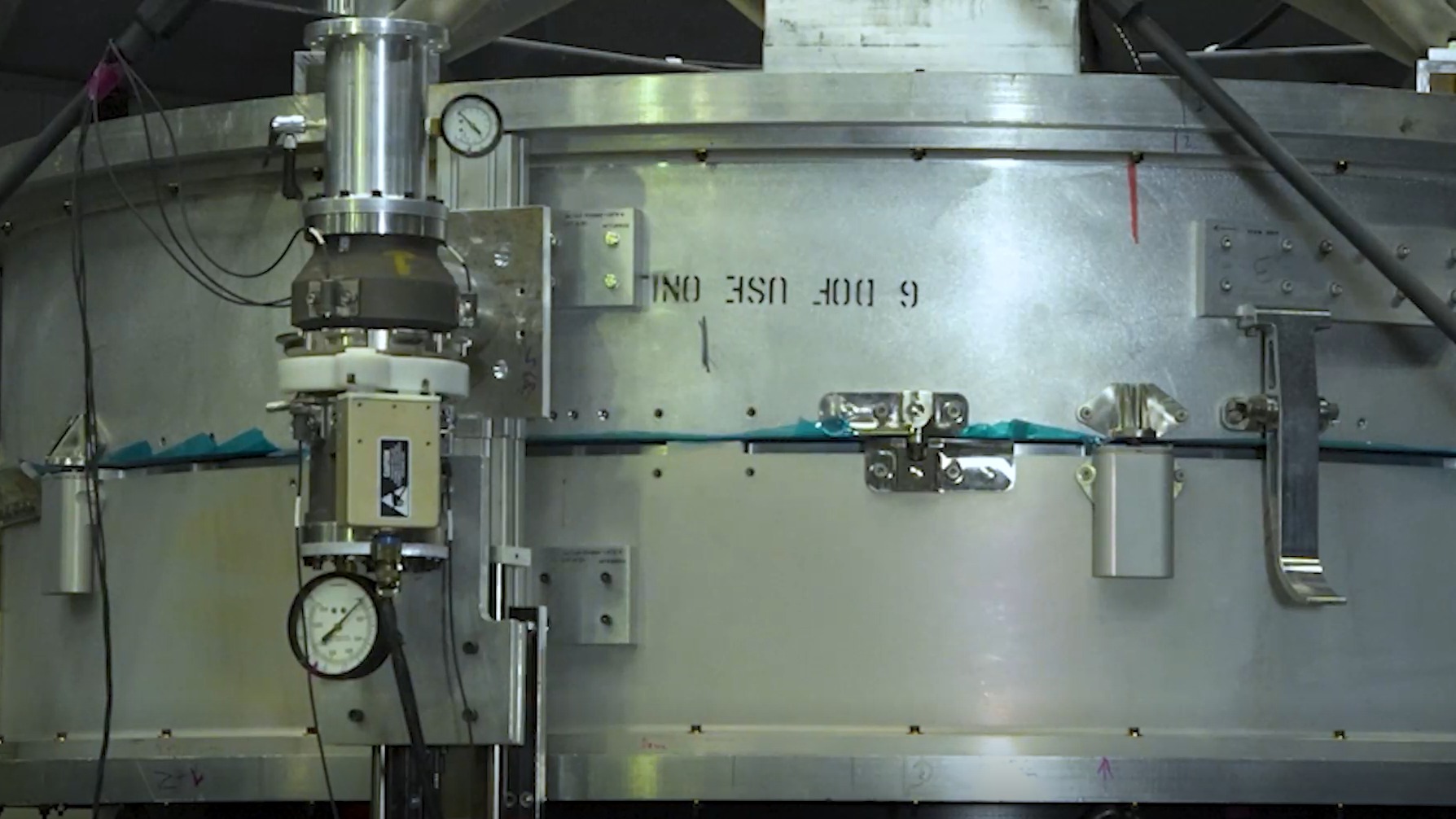
Getting humans to Mars may one day require spacecraft to refuel in Earth orbit. NASA has just tested a NASA cryocoupler that could make that possible. This device transfers super-cold propellants between two vehicles in space.
It was developed by defense contractor L3Harris. Engineers tested it at NASA’s Marshall Space Flight Center in Huntsville, Alabama. Think of it as the nozzle on a gas pump. Except it dispenses liquid hydrogen and liquid oxygen at hundreds of degrees below zero Fahrenheit. No astronaut spacewalk is required.
What NASA Actually Tested
A joint NASA and L3Harris team ran two types of ground tests. First, they pushed liquid nitrogen at minus 321 degrees Fahrenheit through the cryocoupler. Engineers tested both connected and disconnected configurations. They wanted to see how the device handles thermal contraction, fluid flow, and steep temperature differences.
Second, the team mounted one half of the coupler on a robotic table. This table could move and rotate in any direction, simulating misaligned docking. It’s a realistic scenario where a spacecraft and an orbiting fuel depot aren’t perfectly aligned when they connect. The cryocoupler tolerates some degree of off-axis coupling.
Why In-Orbit Refueling Matters for Mars
The engineering rationale is straightforward. A spacecraft launched from Earth can only carry so much fuel before weight becomes prohibitive. However, if that same craft could dock with an orbiting propellant depot, it could top off its tanks before departing for Mars.
Ground-based couplers like those used to fill the Space Launch System won’t work in orbit. They release quickly during launch and require manual reconnection. Additionally, they are not built for the thermal and vacuum conditions of space. The cryocoupler under development at Marshall is fully automated, sized for expected orbital tank designs, and can attach and detach multiple times.
Still Early, But Fully Automated
“In-orbit cryogenic refueling between two spacecraft has yet to be done and remains one of the toughest engineering challenges in spaceflight,” said Travis Belcher, cryocoupler project manager at Marshall. “These propellant transfers are essential for the kinds of missions NASA wants to fly in the future.”
The couplers are fully automated. Astronauts would not need to perform a spacewalk to transfer fuel. Each unit can also attach and detach multiple times across different refueling cycles.
However, Belcher was clear about where the technology stands today. “These cryocouplers are very early in development, so the testing is mostly focused on basic functionality,” he noted. Future test campaigns will tailor the hardware to specific missions and evaluate it against mission-specific requirements.
Part of a Bigger NASA Push
Testing was conducted under NASA’s 2022 Announcement of Collaboration Opportunity. That program lets NASA centers provide companies with expertise, facilities, hardware, and software at no cost. Meanwhile, a cross-agency team spanning Marshall and NASA’s Glenn Research Center oversees cryocoupler development as part of a broader orbital refueling effort.
The work builds on a steady drumbeat of NASA milestones aimed at deep-space readiness. Recently, the agency named the crew for its critical Artemis III test flight in 2027. Its Perseverance rover continues breaking distance records on the Martian surface. Furthermore, NASA’s Psyche probe recently used a Mars gravity assist on its way to a metal asteroid. Cryocoupler testing adds another piece to that infrastructure. It could determine whether deep-space missions refuel on the ground or fill up after leaving it.